Written by: Nobuko Japan Vehicle Sourcing Team
Experience: 14 years in Japanese used vehicle sourcing
Fact Checked by: Nobuko Japan Auction Review Team
A Japanese imported car can look excellent in photographs and still have an auction history that changes the buying decision. Mileage, previous repairs, auction grade and inspector comments can reveal information that is difficult to identify from an advertisement alone.
Free Auction Sheet Verification is the process of checking whether available Japanese auction information matches the vehicle you are considering. A proper check connects the chassis number with recorded mileage, auction grade, body condition, repair information and inspector observations.
For international buyers, one of the biggest challenges is understanding the original Japanese report. Auction sheets contain Japanese inspector comments, condition codes and damage markings that need to be understood before they can be properly verified.
This is where the Nobuko Japan Auction Sheet Translator becomes useful. It converts Japanese auction information into an easier English report so buyers can understand the evidence before making a purchase decision.
Quick Answer: To verify a Japanese auction sheet, first confirm the chassis number, then check mileage, auction grade, body damage and inspector comments. Translate anything you do not understand and investigate important inconsistencies before buying the vehicle.
How to verify a Japanese auction sheet
How chassis number verification works
How to check mileage and auction grades
What damage symbols and inspector comments can reveal
The difference between translation, verification and inspection
Which red flags require further investigation
Translate Your Japanese Auction Sheet Free
Free Auction Sheet Verification refers to an initial check of a Japanese vehicle's available auction information before paying for a deeper vehicle history service or committing to the purchase.
A Japanese used car auction sheet is created when a vehicle is inspected for sale through a Japanese auction. Depending on the auction house and vehicle, the report can include the chassis or frame number, odometer reading, auction grade, interior grade, body damage diagram, specifications and inspector comments.
Verification asks a different question from simply reading the sheet:
Does this information actually belong to the vehicle being sold, and does it support the claims being made about the car?
A document can look genuine and still be irrelevant if its chassis number belongs to another vehicle.
For this reason, professional verification should always begin with vehicle identity rather than an attractive grade or low mileage figure.
Nobuko Verification Principle: Never verify the grade before verifying the car.
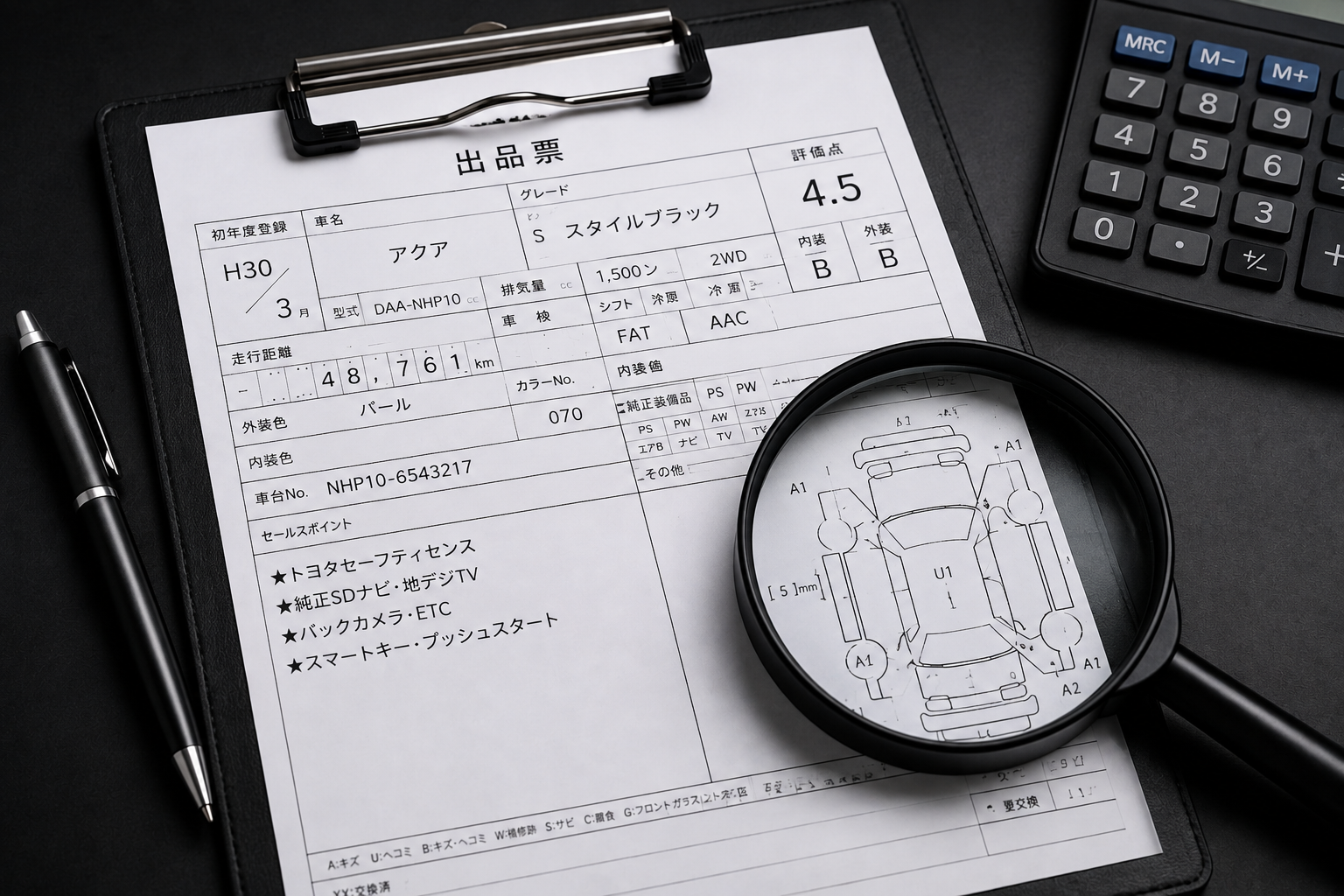
Japanese auction sheet verification matters because mileage, repair history and vehicle condition directly affect buying risk and resale value.
Imagine two Toyota Aquas that look almost identical today.
The first previously appeared at auction with Grade 4.5, consistent mileage and only minor body marks. The second appeared as an R grade vehicle with recorded repair history.
Both cars may look clean after preparation, but their histories are different.
An auction sheet gives buyers another layer of evidence before purchase. It can help identify mileage inconsistencies, previous body repairs, replaced panels, corrosion, interior condition and inspector observations.
This is particularly valuable when buying a vehicle remotely from Japan because photographs show appearance, while the auction report adds historical condition information.
A clean vehicle today does not erase what was recorded about it at auction.
Before verifying the seller's description, you need to understand what the original report actually says.
A Japanese auction sheet can contain printed information, handwritten inspector comments, abbreviations and body damage codes. Looking only at the headline grade can therefore give an incomplete picture.
For example, a Grade 4 vehicle may still have dents, scratches, previous panel repairs or comments requiring attention. An R or RA vehicle may look visually excellent but have recorded repair history.
This is why Japanese auction sheet translation should be part of the verification process.
The Nobuko Japan Auction Sheet Translator turns auction sheet information into an easier English report covering important vehicle details, auction grade, inspector comments and damage information.
Users can currently translate up to three auction sheets without signing in. Signing in provides access to more translations, recent translation history and downloadable PDF reports.
The safest approach is to use the same process for every Japanese import.
The chassis number or frame number connects an auction record to an individual vehicle.
Check the identifier on the vehicle and compare it with the auction sheet and available import documentation.
If the numbers do not match, stop.
A genuine auction sheet for another Toyota Prius does not verify the Prius you are considering.
Check the model, model code, registration information, engine specification and other available details.
These details provide a second identity check and may reveal specification differences that affect value.
Compare the mileage recorded at auction with later available records.
Mileage should normally progress logically over time.
For example:
First record: 46,000 km
Later record: 51,500 km
That progression is reasonable.
But:
First record: 91,000 km
Later record: 63,000 km
requires further investigation.
A mileage inconsistency is a reason to investigate, not automatic proof of odometer fraud.
The overall grade provides a useful starting point for understanding condition.
But never make a buying decision from grade alone.
Finally, connect the body diagram with the written inspector observations.
This is where translation becomes particularly valuable because an important comment may completely change how the headline grade should be interpreted.
For a faster and more consistent review, use the Nobuko Five Point Verification Framework:
| Check | What You Review | Main Question |
| Identity | Chassis, model, specification | Is this the same vehicle? |
| Mileage | Auction and later records | Is mileage progression logical? |
| Grade | Overall and interior grade | What was its auction condition? |
| Damage | Body map and repair codes | What defects or repairs were recorded? |
| Inspector Notes | Written observations | What needs further investigation? |
This framework prevents one attractive number from controlling the entire decision.
A Grade 4.5 vehicle with inconsistent mileage deserves investigation. A low-mileage vehicle with significant repair history should not automatically be treated as better stock.
The strongest Japanese car purchase is supported by several pieces of evidence, not one attractive auction grade.
Japanese auction sheet grades provide a general indication of vehicle condition at the time of auction inspection.
Exact grading practices can vary between auction houses, but buyers commonly encounter:
| Grade | General Interpretation | Buyer Response |
| S / 6 | Very high condition | Confirm complete sheet |
| 5 | Excellent | Check minor defects |
| 4.5 | Very good | Review body diagram |
| 4 | Good used condition | Check marks and comments |
| 3.5 | Wider condition range | Inspect carefully |
| 3 | More wear or preparation | Calculate repair cost |
| R / RA | Repair history | Investigate repairs |
| 2 | Poor condition | High caution |
An R or RA grade should not automatically mean “do not buy.”
The better questions are: What was repaired? How serious was it? What does the body diagram show? Is the repair quality acceptable? Is the price appropriate for the history?
The grade tells you where to start.
The complete auction sheet tells you what to investigate.
The body diagram records exterior condition using letters and numbers.
Common auction sheet symbols can indicate scratches, dents, previous repair work, corrosion or replaced panels. The exact notation can differ between auction houses, so symbols should always be interpreted in the context of the complete report.
A small scratch on a bumper does not carry the same buying risk as corrosion, structural repair or several replaced panels.
This gives buyers a useful rule:
Damage Impact = Type + Severity + Location + Quantity
Inspector comments add another layer.
They may mention interior wear, warning lights, mechanical observations, previous repair, rust, smells, missing equipment or other condition issues.
This is why translating only the printed vehicle information is not enough.
The handwritten or inspector-written section can contain some of the most commercially important information on the sheet.
Translate Inspector Comments with Nobuko Japan
These three processes should never be treated as the same thing.
Translation answers: What does the Japanese auction sheet say?
It converts Japanese comments, grades and condition information into understandable language.
Verification answers: Does the available evidence match the vehicle and its claimed history?
It compares chassis identity, mileage, grade, repair information and other available records.
Inspection answers: What condition is the vehicle in today?
An auction sheet is historical evidence. The vehicle can experience transport damage, storage, repairs, repainting or mechanical deterioration after the auction.
The stronger buying workflow is therefore:
Translate → Verify → Inspect → Calculate → Decide
This distinction is important for both private buyers and dealers.
Free Auction Sheet Verification is best used as an initial risk check rather than a guarantee of the vehicle's complete history.
A basic check may help you understand the auction sheet and identify obvious inconsistencies. A deeper historical check becomes more valuable when the vehicle has unclear mileage, significant repair history, multiple auction appearances or conflicting information.
| Situation | Initial Check | Deeper Check |
| Chassis matches | Usually enough to continue | If other issues appear |
| Mileage consistent | Continue review | Optional |
| R / RA grade | Review carefully | Recommended |
| Mileage conflict | Insufficient | Recommended |
| Multiple records | Compare timeline | Useful |
| High-value vehicle | Basic screening | Strongly considered |
The important principle is not whether a check is free or paid.
The important question is whether you have enough evidence to make the purchase decision.
Some inconsistencies deserve immediate attention.
A chassis mismatch is one of the strongest warnings because the sheet cannot verify a different vehicle.
A mileage reversal also requires investigation. If an older record shows higher mileage than a newer record, ask for supporting evidence before proceeding.
A grade discrepancy can materially affect value. If one record presents the vehicle as Grade 4.5 while another valid record for the same chassis indicates R, the repair history needs to be understood.
Be careful with cropped auction sheets as well. A screenshot showing only mileage and grade may remove the damage map and inspector comments that provide essential context.
None of these signs should automatically be turned into an accusation.
They should change the next action from buy to investigate.
Consider a Toyota Prius advertised as:
Grade 4.5 | 48,000 km | Clean Japanese Import
The photos look excellent.
During the verification process, an earlier auction record for the same chassis shows:
Grade R | 46,800 km
The mileage progression appears logical, but the grade history creates an important question.
The buyer should now review the complete auction information, translate the inspector comments, understand the repair area and inspect the vehicle's current condition.
The decision relied on:
Photos + Seller Description
The decision uses:
Chassis + Mileage + Grade + Repair Evidence + Current Inspection
The verification process has not automatically proved that the Prius is a bad purchase.
It has produced a better-informed buying decision.
For dealers, auction verification is not only about avoiding bad cars.
It is also about protecting margin.
A vehicle with undisclosed body repair, interior damage or questionable mileage may require more preparation and may be harder to retail at the expected price.
Before bidding, dealers should connect auction information to commercial value:
Expected Selling Price − Import Costs − Preparation Cost − Required Margin − Risk Buffer = Maximum Buying Budget
A cheaper vehicle at auction can become more expensive after repairs.
This is why Nobuko Japan recommends reviewing the complete auction information before deciding how much a vehicle is worth.
Free Auction Sheet Verification is an initial process for checking whether available Japanese auction information matches the vehicle being considered, including chassis identity, mileage, grade and condition.
Start with the chassis number, understand the complete auction sheet, compare mileage and grade, review damage and inspector comments, then investigate any important inconsistency.
Use a translation process that covers both printed information and inspector comments. The Nobuko Japan Auction Sheet Translator converts auction information into an easier English report for review.
An auction sheet provides historical mileage evidence. Stronger mileage verification compares that figure with other available records in chronological order.
R and RA generally indicate repair history. Buyers should investigate the location and severity of repairs rather than automatically accepting or rejecting the vehicle.
No. A high grade is a useful condition indicator, but buyers should still review mileage, damage diagrams and inspector comments.
Free Auction Sheet Verification helps Japanese car buyers move from seller claims to evidence-based buying decisions.
Start by understanding the original auction report. Then use the Nobuko Five Point Verification Framework:
Identity → Mileage → Grade → Damage → Inspector Notes
The chassis confirms which vehicle you are reviewing. Mileage provides a historical reference. The auction grade gives an initial condition signal. Damage markings reveal recorded defects or repairs, while inspector comments provide context that numbers alone cannot show.
Most importantly, separate translation from verification and verification from current inspection.
Understand the sheet. Verify the evidence. Inspect the vehicle. Then decide what it is worth.
Nobuko Japan Vehicle Sourcing Team has 14 years of experience working with Japanese used vehicles, auction information, vehicle sourcing and international buyers.
The team works with Japanese auction sheets, auction grades, mileage information, vehicle condition reports and sourcing requirements when evaluating used vehicles for export. This guide combines practical Japanese vehicle sourcing experience with a structured approach to auction sheet interpretation and verification.
Fact Checked by: Nobuko Japan Auction Review Team
Last Reviewed: 17 August 2026
Disclosure: This educational guide is published by Nobuko Japan and includes references to Nobuko Japan's own Auction Sheet Translator.
For Latest updates

The Japanese car auction market is continuously evolving with time. They offer buyers worldwide acce...

Japanese brands are the smart choice when you need a reliable car. In fact, companies like Toyota an...

Cost Breakdown of Importing a VehicleThinking about importing a car? Then you're at the right place....
.webp)
Why the Toyota Alphard is Gaining Popularity in the UKThe Toyota Alphard car has literally taken the...
Check out other articles related to Market trend.