
The Honda Stepwagon has quietly become one of the smartest imports available to UK buyers, and 2026 is an unusually good year to be looking at one.
Two things changed. Import duty on Japanese-built cars entering the UK fell to 0% under the UK-Japan trade agreement, down from 1.3% the year before. And the 2015-onward generation... the one with the 1.5-litre turbo, the hybrid option and the distinctive side-opening tailgate... has now crossed the ten-year threshold that exempts imported vehicles from the IVA test. That combination removes the two biggest costs and complications in one go.
What you get is an eight-seat MPV with sliding doors on both sides, a genuinely low floor, Honda mechanical engineering and a price that makes a VW Transporter look eccentric.
This guide covers which generation to buy, honest reliability, real fuel figures, what it costs to land in the UK, and what to check before bidding.
This guide combines 14 years of Japanese auction sourcing and UK export experience with UK customs, IVA and DVLA requirements verified in August 2026. Duty treatment reflects the UK-Japan CEPA position from 2026. Fuel figures are Japanese test-cycle numbers with real-world ranges noted separately, since JC08 figures flatter considerably. Vehicle tax treatment for imports varies with the documentation available to DVLA... confirm your specific case before budgeting.
They are the same vehicle. If you are searching auction listings or UK classifieds, try both spellings... stock gets listed under each, and searching only one halves what you see.
It has been in continuous production since 1996 across six generations, making it one of Honda's longest-running nameplates and one of the most abundant MPVs in the Japanese auction system.
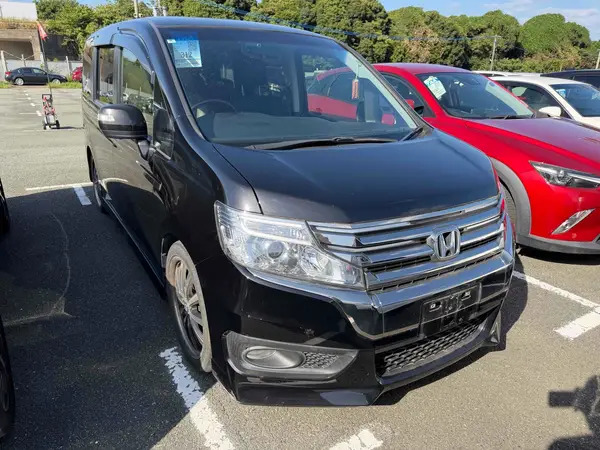
The cheapest route in. A 2.0-litre petrol, conventional tailgate, and a low floor that was class-leading at the time. Mechanically straightforward and well supported. Best for: buyers who want maximum space for minimum outlay and are relaxed about equipment levels.
A refinement of the same idea with better interior quality and improved packaging. Still 2.0-litre petrol. Plentiful at auction and comfortably the value sweet spot for a straightforward eight-seat family vehicle. Best for: the practical buyer who wants a known quantity.
This is where the Stepwagon got interesting. Honda replaced the 2.0 with a 1.5-litre VTEC Turbo, added a hybrid option in the Spada Hybrid, and fitted the Waku Waku Gate... a tailgate that opens sideways as well as upwards.
Crucially, the earliest RP cars are now over ten years old, which changes their UK import treatment entirely. Best for: buyers who want modern equipment, better economy and the simplest possible UK registration route.
The current car, larger and more conventional. Honda dropped the Waku Waku Gate. Still under ten years old, so IVA applies. Best for: buyers wanting the newest vehicle and willing to handle IVA.
Imported vehicles over ten years old are exempt from Individual Vehicle Approval. Instead of putting the car through IVA... which costs money, takes time and can require modifications... a vehicle over ten years old can be registered through the MOT route.
The earliest RP-series Stepwagons were built in 2015. In 2026, they have crossed that threshold.
That means the generation with the turbo engine, the hybrid option, the modern safety equipment and the side-opening tailgate is now available on the simplest registration path.
Combine that with 0% import duty on Japanese-built vehicles under the UK-Japan Comprehensive Economic Partnership Agreement, and the total cost of putting an RP Stepwagon on UK plates has fallen meaningfully compared with two years ago.
A caveat worth stating: the ten-year clock runs from the date of manufacture, not the model year. A car built late in 2015 and a car built early in 2016 are treated differently. Verify the build date, not the registration year.
Honda's naturally aspirated 2.0 i-VTEC. Unstressed, reliable and widely understood by UK independent garages. Adequate rather than quick, particularly fully loaded.
Japanese test cycle: around 12–13 km/l. Realistic UK driving: roughly 26–31 mpg.
Honda's L15B turbo, producing around 150 PS with strong low-end torque. It moves a loaded eight-seater far better than the displacement suggests, and it is noticeably more economical than the old 2.0.
Japanese test cycle: around 15–17 km/l. Realistic UK driving: roughly 33–39 mpg.
Honda's two-motor hybrid system. In town it runs primarily on electric power with the engine acting as a generator, which suits school runs and urban driving very well.
Japanese test cycle: around 20–25 km/l. Realistic UK driving: roughly 40–48 mpg, considerably less on sustained motorway runs where the system's advantage narrows.
A note on JC08 figures. Japanese test-cycle numbers are optimistic. Treat the real-world ranges above as your planning figures, not the headline JC08 number on a listing.
The 2.0 petrol (RG, RK) is the safest bet mechanically. It is a long-serving, unstressed Honda engine with no widespread structural weaknesses. Normal ageing items... suspension bushes, exhaust components, sliding door mechanisms... are what you will spend on.
The 1.5 turbo (RP) is strong, but Honda's 1.5 turbo family attracted reports of fuel dilution of engine oil, most commonly in cold climates and short-journey use. Honda addressed it through software and service updates. It is not a reason to avoid the engine, but it is a reason to favour cars with documented servicing and to check oil condition and level carefully.
CVT transmissions feature across later generations. They are generally durable when fluid changes have been done. Neglected CVT fluid is the single most common expensive failure on Japanese MPVs of this type... ask about service history specifically.
Sliding doors are the other wear point on any MPV. Powered doors on higher grades have motors and cables that age. Test both sides thoroughly.
Rust is climate-dependent... covered below.
Unique to the RP generation, and genuinely useful rather than a gimmick.
The tailgate opens two ways. Lift the whole thing conventionally for loading bulky items, or swing just a portion of it sideways like a door when you are parked tight against a wall or another car.
Anyone who has tried to retrieve a bag from a conventional tailgate in a packed British supermarket car park will understand the appeal immediately.
Why Honda dropped it for the 2022 RP6: reception was mixed in Japan, with criticism of the split-line appearance and some added weight and complexity.
For a UK buyer, that makes the RP generation more interesting, not less... it is a feature nothing else on the UK road has, and it is only available on the generation that has just become IVA-exempt.
Seating. Seven or eight seats depending on configuration, with second-row captain's chairs on many grades. The third row folds away properly rather than simply tipping forward, leaving a genuinely usable load bay.
The low floor is the Stepwagon's real engineering achievement. Honda's packaging puts the fuel tank under the front seats, which drops the cabin floor and delivers standing-height headroom and easy access for children and older passengers.
Sliding doors on both sides, powered on higher grades.
Camper conversions. This is a large and growing UK use case. The Stepwagon's flat floor, standing headroom and compact external footprint make it a strong micro-camper base, and it costs a fraction of a VW Transporter of equivalent age. UK converters increasingly work with Japanese MPVs for exactly this reason.
Worth checking before you commit to a conversion plan: internal height with the roof unmodified, and whether your intended layout works around the wheel arches.
Import duty: 0% for Japanese-manufactured vehicles under the UK-Japan Comprehensive Economic Partnership Agreement, which completed its tariff phase-out in 2026, down from 1.3% in 2025.
This is not automatic. The exporter must supply a statement on origin with the shipping documents, with the Japanese export certificate serving as supporting proof. Without it, HMRC applies the standard 10% rate. Confirm your exporter will provide it before the car ships... it cannot be fixed afterwards.
VAT: 20%, charged on the CIF value plus any duty. This is unchanged by the tariff reduction.
The compounding effect. On a car with an £8,000 purchase price and £1,500 shipping, securing 0% duty rather than 10% saves roughly £1,150 once the knock-on VAT reduction is counted... because VAT is charged on the duty as well as the car.
Other costs: port clearance, agent fees, MOT or IVA, DVLA registration, and UK plates.
For the full duty and VAT breakdown, see our dedicated UK import duty guide.
Vehicle Tax The 1,549cc Detail
Here is a quirk that genuinely affects which Stepwagon you should buy.
Imported vehicles registered after March 2001 without an approved UK CO2 figure are commonly taxed by DVLA under the Private/Light Goods regime, which is based on engine size rather than emissions. The threshold sits at 1,549cc.
The 2.0-litre RG and RK sit above that threshold and pay the higher PLG rate.
The 1.5-litre turbo in the RP is 1,496cc... below the threshold, and therefore in the lower band.
Same vehicle family, two different annual tax bills, decided by 53cc.
Verify rather than assume. Whether PLG applies depends on what CO2 documentation DVLA accepts for your specific car, and treatment can vary. But if you are weighing an RK against an RP and the running costs look close, this is the detail that separates them over several years of ownership.
Step 1.Source and win at auction through a licensed exporter, with the full translated auction sheet in front of you.
Step 2.Secure the statement on origin. Required for 0% duty. Confirm before shipping.
Step 3.Deregistration and export documentation in Japan, with the export certificate translated.
Step 4.Shipping by RoRo or container, typically to Southampton, Bristol or Tilbury.
Step 5.Customs clearance. Your agent files the import declaration and settles duty and VAT before release.
Step 6.NOVA. Notify HMRC of the vehicle's arrival within 14 days using the Notification of Vehicle Arrivals system. This is a hard deadline.
Step 7. Approval. Vehicles over ten years old: MOT route. Under ten years: Individual Vehicle Approval, which may require modifications.
Step 8.DVLA registration. Submit the application with supporting documents and receive your UK registration.
Common modifications for UK compliance: rear fog lamp, speedometer showing mph, and headlamp checks... though Japan and the UK both drive on the left, which removes the beam-pattern problem most import markets face.
Rust and corrosion markings. Cars from northern Japan... Hokkaido, Tohoku, Niigata... see salted roads through winter and their underbodies can be markedly worse than a car from Kyushu or Kanto. In a damp UK climate this matters. Ask where the car came from, not just what grade it holds.
Interior grade, scored separately. On an eight-seat family vehicle, wear patterns tell you a great deal about how hard it has worked.
Sliding door operation... note any markings around the door apertures.
Mileage verification flags. The sheet indicates when a reading cannot be confirmed. Take it seriously.
Service history, particularly CVT fluid changes and, on the 1.5 turbo, oil service records.
Build date, not model year... it decides your IVA position.
Grade and equipment. Spada denotes the sportier trim with different bumpers and equipment. Verify against the sheet rather than the listing title.
| Vehicle | How it compares |
| Toyota Noah / Voxy | The direct rival, similarly abundant. Toyota's hybrid system is more widely understood by UK garages. Stepwagon has the more interesting tailgate and, in 1.5 turbo form, the tax advantage |
| Nissan Serena | Comparable space, e-Power versions excellent in town. Servicing familiarity in the UK is thinner |
| Toyota Alphard | Larger, plusher, considerably more expensive to buy and run. A different class of vehicle |
| VW Transporter (UK) | The default UK camper base. Far more expensive for equivalent age and condition, with poorer reliability records and a much higher purchase price |
The honest summary: if you want maximum space per pound with Honda engineering, the Stepwagon is very hard to beat. If you want the widest UK servicing familiarity, a Toyota Noah or Voxy has a slight edge.
Q1. Is the Honda Stepwagon reliable?
Generally yes. The 2.0 petrol is the most proven. The 1.5 turbo is strong but favour cars with documented servicing, as Honda's 1.5 turbo family saw reports of fuel dilution in oil during cold-climate, short-journey use. CVT fluid history matters on all later cars.
Q2. How much does it cost to import a Honda Stepwagon to the UK?
Import duty is 0% for Japanese-built vehicles with a valid statement on origin, plus 20% VAT on the CIF value. Add shipping, clearance, agent fees, MOT or IVA, and DVLA registration.
Q3. Do I need an IVA test for a Honda Stepwagon?
Not if the vehicle is over ten years old at import... those register via the MOT route. Under ten years, IVA applies. Check the build date rather than the model year.
Q4. What is the Honda Stepwagon fuel economy?
Realistically, around 26–31 mpg for the 2.0 petrol, 33–39 mpg for the 1.5 turbo, and 40–48 mpg for the hybrid in mixed driving. Japanese JC08 figures are considerably more optimistic.
Q5. What is the Waku Waku Gate?
A tailgate on the 2015–2022 RP generation that opens both upward conventionally and sideways as a door, making access easy in tight parking spaces. Honda discontinued it for the 2022 model.
Q6. Is the Stepwagon good as a camper conversion base?
Yes. Its flat, low floor, standing headroom and compact external dimensions suit micro-camper conversions, at a fraction of the cost of a VW Transporter of similar age.
Q7. How many seats does a Honda Stepwagon have?
Seven or eight depending on configuration, with sliding doors on both sides and a third row that folds away to leave a usable load area.
Q8. Stepwagon or Toyota Noah?
Both are excellent. The Stepwagon offers the Waku Waku Gate and, in 1.5 turbo form, a potential vehicle tax advantage. The Noah and Voxy benefit from broader Toyota servicing familiarity in the UK.
About the Nobuko Japan Vehicle Sourcing Team
The Nobuko Japan Vehicle Sourcing Team has 14 years of experience working with Japanese used vehicles, auction information, vehicle sourcing and international buyers.
This guide covers which Honda Stepwagon generation to import, engine and reliability differences, real-world fuel economy, the 0% duty position and IVA exemption that make 2026 favourable, UK vehicle tax treatment, and what to check on the auction sheet before bidding.
The team works with Japanese auction sheets, auction grades, mileage information, vehicle condition reports and sourcing requirements when evaluating used vehicles for export. This guide combines practical Japanese vehicle sourcing experience with a structured approach to auction sheet interpretation and verification.
Source Your Stepwagon from the Auction Floor
Build date, grade, service history and the region the car came from all matter more on an eight-seat MPV than on almost anything else... and all four are visible on the auction sheet before you bid, if someone translates it properly.
Nobuko Japan bids across Japanese auction houses, translates the full auction sheet including the condition map, supplies the statement on origin needed for 0% UK duty, and handles export documentation and shipping.
For Latest updates

The Japanese car auction market is continuously evolving with time. They offer buyers worldwide acce...

Japanese brands are the smart choice when you need a reliable car. In fact, companies like Toyota an...

Cost Breakdown of Importing a VehicleThinking about importing a car? Then you're at the right place....
.webp)
Why the Toyota Alphard is Gaining Popularity in the UKThe Toyota Alphard car has literally taken the...
Check out other articles related to Market trend.