When buying a used vehicle from Japan, knowing its age is not as simple as checking the model year. The Japanese car first registration date can be different from its manufacture date. In fact, that difference can matter when a destination country applies an age limit to imported used vehicles.
The safest method of verification would be the use of legitimate Japanese vehicle documentation such as the Japanese export certificate, which will correspond with the chassis number. The information provided in the auction sheet may serve as supportive information. However, it should never substitute legitimate documentation in cases of checking for import eligibility.
This article provides the procedure of verifying the first registration date of a Japanese car, its location, differences from the manufacturing date, and other information that needs to be verified before purchasing a vehicle under a 5-year rule.
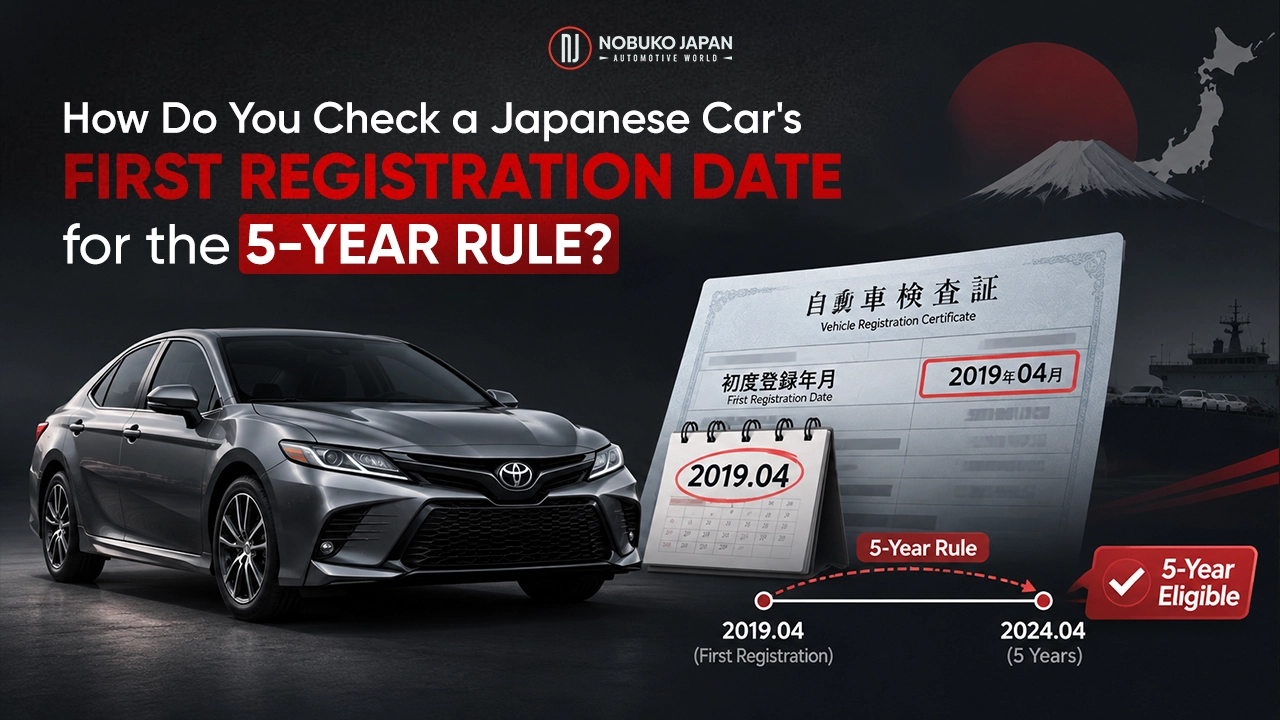
The Japanese car first registration date refers to when the vehicle was first registered for road use in Japan. Japanese vehicle records commonly identify the first registration by year and month.
Japan's Ministry of Land, Infrastructure, Transport and Tourism, or MLIT, uses the concept of shodo toroku nengetsu, meaning the year and month of first registration, in its vehicle registration system. This information helps establish when a vehicle officially entered registered use.
No. The Japanese car registration year should not automatically be treated as the model year or production year. A vehicle could have been manufactured near the end of one year and registered several months later. This is why a proper Japanese car age check should use the exact type of date required by the importing country's rules.

A Japanese car 5 year rule normally refers to an import restriction that limits used vehicles according to age. However, there is no single global 5-year rule. Every importing country can define vehicle age differently.
Some regulations may rely on the manufacture date, while others may consider registration or another official date. The cut-off may also be calculated against the shipment, arrival, import, or registration date.
This distinction is critical. For example, Pakistan's official Trade Information Portal explains that under its personal vehicle import rules, vehicle age is calculated from January 1 of the year following manufacture until the shipment date. Pakistan therefore provides a useful example of why buyers should not assume that every "5-year rule" uses first registration.
Pakistan also introduced commercial imports of used vehicles less than five years old under S.R.O. 1895(I)/2025. This specific restriction was valid till 30th June 2026, as per the policy where the age limit would then be removed.
Expert Advice: Always make sure that you do not depend only on the term "5-year rule". Verify the date from which the age is determined.
The best Japan first registration date check uses more than one piece of vehicle information.
Start with the Japanese car export certificate. This is an important document produced when a vehicle is prepared for export after its Japanese registration is cancelled.
Find the section where the initial registration year and month is displayed. Since the date may be written using Japanese era years rather than Western calendar years, ensure that the date is converted appropriately.
The next step is to do a Japanese car chassis number check.
The chassis or frame number indicates the actual car. Compare the number on the certificate with the one provided by the car. The registration date becomes irrelevant if the certificate does not belong to the actual car.
For instance, a Toyota car’s chassis number will be different from the 17-character VIN found in some other markets
A Japanese auction sheet first registration date can provide another useful reference.
Most often, there is also the year and month of registration of the car as well as data on its mileage, model, grade, color, and condition.
Nevertheless, do not take the auction sheet alone as the only document to prove that your car meets the requirements of legal import eligibility.
The Nobuko Japan verification approach can be kept simple:
Document + Date + Chassis = stronger age verification
Compare the:
If these records are consistent, you have a much clearer picture of the vehicle's age.
Not every document has the same purpose. Use this table before completing a Japanese import car age check.
| Source | Information Available | Best Use | Reliability |
| Export certificate | Registration and vehicle details | Official document check | High |
| Auction sheet | Registration, grade and condition | Supporting history check | High when authentic |
| Chassis number | Vehicle identity | Matching records | Essential |
| Manufacture record | Production period | Manufacture age check | Useful |
| Model year | Model generation/year | General reference | Not enough alone |
For a Japanese export certificate registration date, start with the official certificate and then verify that its chassis information matches the vehicle.
Japan's MLIT maintains the country's vehicle registration framework, and its electronic vehicle inspection information also refers specifically to the vehicle's initial registration year and month. This makes official registration records more useful than a seller simply describing a car as a "2022 model" or "2021 car."
The Japanese car first registration vs manufacture date difference is one of the most common sources of confusion for import buyers. Manufacture date means when the vehicle was produced. First registration date means when it was first registered for road use.
Consider this simple example:
| Detail | Example |
| Manufacture date | November 2021 |
| First registration | February 2022 |
| Model year advertised | 2022 |
| Difference | About 3 months |
If an importing country measures age from manufacture, November 2021 is relevant. If its rules specifically use first registration, February 2022 may be the important date.
This is why a Japanese car manufacture year check and a registration check should not be treated as the same thing. The date printed in a sales listing should never replace the date required by the importing country's law.
A correct Japanese vehicle age verification can prevent problems before payment and shipment.
A seller may call a vehicle a "2022 model," but that description does not prove its exact production or first registration date.
The Japanese car manufacture date may come before first registration. Check which one your destination country actually uses.
Documents should match the exact vehicle. Always compare the chassis or frame number before relying on a certificate or auction sheet.
Do not simply subtract five from the current year. The relevant cut-off could depend on shipment date, import date, arrival date, manufacture year or another point set by local law.
Vehicle import policies change. Pakistan is a clear example. Initially, SRO 1895(1)/2025 allowed the importation of commercial vehicles of under five years old up to 30th June 2026. Subsequently, other fiscal laws were enacted that further regulated used vehicles imports including 30% regulatory duty levied after June 30, 2026. Always verify the current ruling from the government before making a purchase decision.
Check the vehicle's Japanese export certificate and find its first registration year and month. Then match the chassis number on the document with the vehicle. An authentic auction sheet can provide supporting information.
First identify the manufacture and first registration information. Then check which date your destination country's import law uses and calculate the vehicle age according to that country's official method.
The Japanese vehicle registration date can appear on official Japanese vehicle records and export documentation. Look for the first registration year and month rather than relying only on a model year stated in a sales advertisement.
Yes, Japanese auction sheets commonly provide registration information, making them useful for a Japanese auction sheet first registration date check. However, official documents should still be reviewed for import compliance.
No. A car may be manufactured in one month or year and first registered later. Always check both dates when buying a Japanese used vehicle.
Checking the registration date of the Japanese car before purchasing will prevent you from selecting a car which may not satisfy your import requirements. The first document to check is the Japanese Export Certificate, followed by the chassis number and the auction sheet as evidence.
Above all, don't confuse the manufacture date, model year and first registration date since they may vary. Import age limit is determined by the destination country's regulations.
Next Steps:
Author Bio
Nobuko Japan is a trusted Japanese used car supplier helping buyers source quality vehicles from Japan. Our content is based on industry knowledge, official sources, and current import information.
Disclaimer
This article is for general information only. Vehicle age limits and import rules vary by country and may change. Always check the latest requirements with the relevant authorities before importing a vehicle.
For Latest updates

The Japanese car auction market is continuously evolving with time. They offer buyers worldwide acce...

Japanese brands are the smart choice when you need a reliable car. In fact, companies like Toyota an...

Cost Breakdown of Importing a VehicleThinking about importing a car? Then you're at the right place....
.webp)
Why the Toyota Alphard is Gaining Popularity in the UKThe Toyota Alphard car has literally taken the...
Check out other articles related to Market trend.