
There is more to buying a car in Japan than the auction price. The final price comes as a great shock to many Pakistani customers since they do not take into consideration all the extra charges.
What you pay will comprise shipping, insurance, port charges, and a number of other government taxes and duties. This guide is easy and straightforward, offering transparently explained breakdown of all the cost elements. It is necessary to understand this complete breakdown.
It assists you in budgeting and keeps you in control of any costs that might arise at the port and also makes you have the final on-road price before you even bid a car. A successful and cost effective import will be possible only by knowing every cost in advance.
Knowing the complete cost structure protects you from overpaying. It prevents exporters or agents from giving you low initial estimates only to surprise you with hidden charges later. A clear breakdown helps you avoid costly storage fees at the Karachi Port by ensuring all funds are ready. Most importantly, it allows you to determine the true final cost of a car before you commit to buying it in Japan.
To know the overall cost use this easy formula:
Total Import Cost = FOB Price + Shipping + Marine Insurance + Port Charges + Customs Duties & Taxes + Clearing Agent Fee + Registration Fee
FOB (Free on Board): The car's price at the Japanese port.
CNF (Cost and Freight): FOB price plus shipping cost to Pakistan.
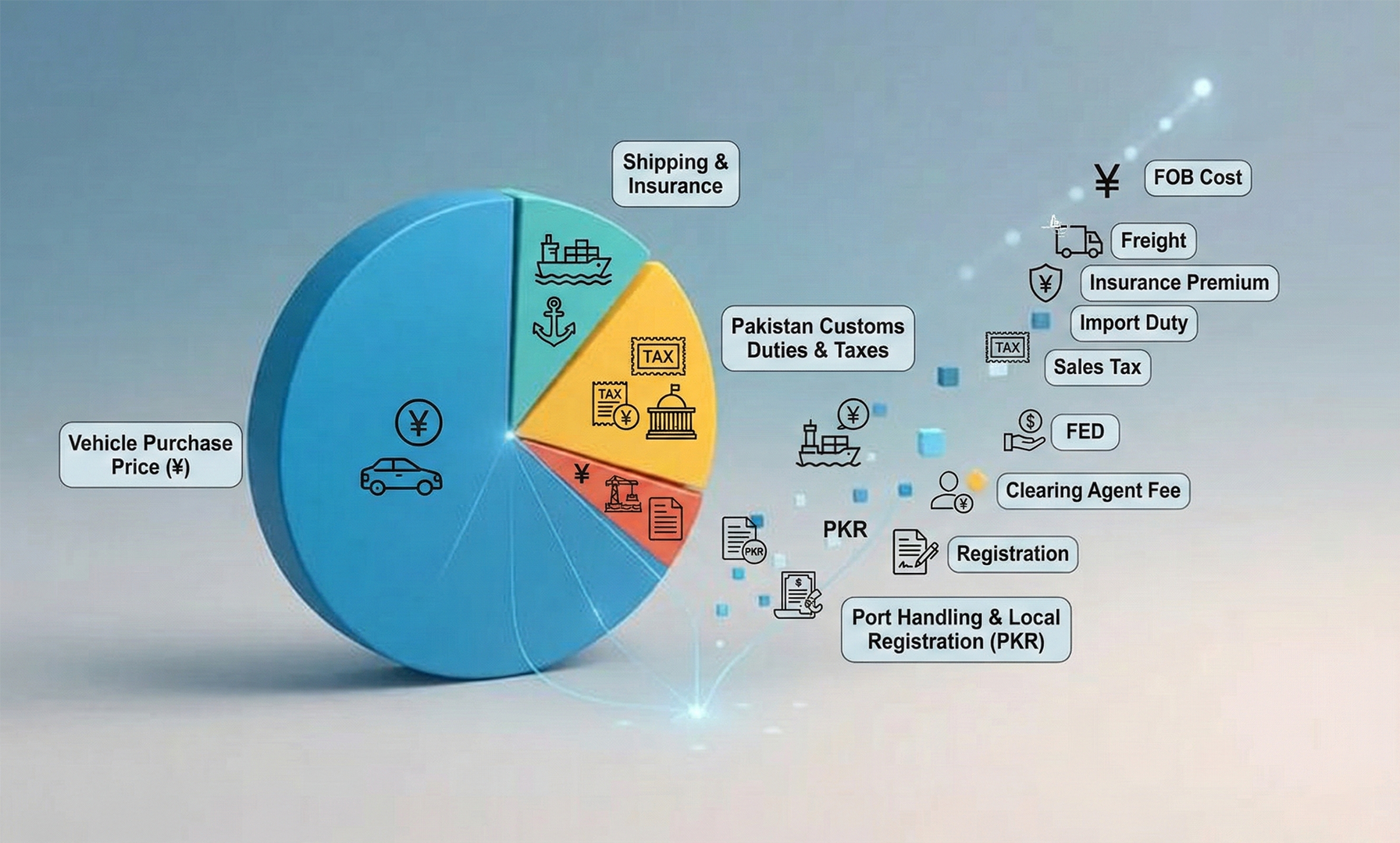
CIF (Cost, Insurance, and Freight): The total value (FOB + Shipping + Insurance) that Pakistan Customs uses to calculate your duties.
Step-by-Step Breakdown of All Import Costs
This is your starting point. It includes:
The winning bid price at the Japanese auction.
The exporter’s commission or service fee.
Cost for the auction sheet and inspection report.
Any yard storage fees in Japan before shipping.
There are two main methods:
RO-RO Shipping: The car is driven onto a specialized ship. This is the most common and cost-effective method for single vehicles.
Container Shipping: The car is placed inside a container. This is more secure but also more expensive, usually for high-value vehicles.
Shipping costs vary by car size. A compact 660cc car will cost less to ship than a large SUV.
This is mandatory. It protects your vehicle against damage or loss during the sea voyage. It typically costs between 1% and 2% of the car’s CIF value.
After the delivery of your car, the port authority will impose a number of charges:
Terminal Handling Charges (THC): For unloading and handling the vehicle.
Scanning Fees: For customs inspection.
Storage/Demurrage: These are daily charges if your car is not cleared from the port quickly. This is a common hidden cost delays are expensive.
This is the most complex part. The Federal Board of Revenue (FBR) is calculating duties on the CIF value, engine size, and the car age. Main components are:
Customs Duty (CD): A percentage of CIF.
Regulatory Duty (RD): Extra duty on some types of vehicles.
Additional Customs Duty (ACD): This is an additional percentage duty.
Sales Tax (ST): A significant tax applied to the total value.
Withholding Tax (WHT): An advance income tax.
Duty variation is critical:
660cc (Kei cars) have the lowest duty rates.
1000cc and 1300cc cars have progressively higher rates.
Hybrid cars often have reduced duty brackets to encourage their import.
EVs (Electric Vehicles) may have special incentives.
Customs uses a valuation table and specific HS codes for classification, not just your invoice price.
A licensed clearing agent handles the complex customs clearance process in the WeBOC system. Their fee is a service charge for this essential work. Always use a licensed agent to avoid legal issues and delays.
After clearing the car from the port, you must register it. This includes:
Registration fee at the local Excise & Taxation office.
Cost for number plates.
Annual token tax payment.
Biometric verification charges.
Costs can vary between cities like Karachi, Lahore, and Islamabad.
Port Storage: Delays in clearance lead to daily demurrage charges.
Exporter Documentation Fee: Some exporters charge extra for paperwork.
Currency Fluctuation: The exchange rate used by Customs can change, affecting your duty amount.
Late Payment Penalties: If duties are not paid on time, you will incur fines.
Use an online FBR duty calculator before bidding.
Compare shipping quotes from different exporters.
Choose RO-RO shipping for standard cars.
Ensure all your documents are ready to clear the car immediately upon arrival.
660cc Kei cars (e.g., Daihatsu Mira, Suzuki Alto) are usually the cheapest due to their low FOB price and lower import duties.
The duty is a percentage of the CIF value, but it is in the lowest tax bracket, making it the most affordable category to import.
They can be. While their FOB price may be higher, their reduced duty rates often make their total landed cost very competitive, especially with massive fuel savings.
Is importing cheaper than buying locally?
Often, yes. You can get a newer, better-equipped, and more reliable car for a similar or lower final cost than a local used car.
Importing a car from Japan can be a cost-effective decision, but only if you understand and plan for all fees. The auction price is just the beginning. Accurate duty estimation and factoring in all ancillary costs are the keys to avoiding financial surprises and making a smart purchase.
For Latest updates
Importing a Japanese vehicle into the UK, Ireland, or Cyprus in 2026 is a smart idea. It's excellent...

Japan's reputation as makers of best Japanese cars; electric-proof, high-tech, and exciting automobi...
.png)
Importing a car from Japan to the UK is an exciting process. However, understanding the shipping tim...

From 2026, Japanese built cars imported to the UK pay 0% import duty under the UK-Japan Comprehensiv...
Check out other articles related to Car Import Tips.