Japan has more used hybrids per capita than anywhere on earth, and the Kanto region around Tokyo is where the largest number of them change hands every week. For an overseas buyer, that concentration is the opportunity.
But there is a misconception worth clearing up immediately. Buying near Tokyo does not automatically mean buying cheaply. Kanto auctions carry the highest volume and often the best-condition stock in the country, which means competition is fierce and hammer prices reflect it. The genuine Tokyo advantage lies elsewhere, and understanding it is what separates a good purchase from an average one.
This guide covers where hybrids are actually traded around Tokyo, which models offer the lowest cost per kilometre of reliable service, how to read an auction sheet, the one thing auction sheets will never tell you about a hybrid, and what a cheap hybrid genuinely costs once it reaches your port.
Not in the way most buyers assume, and it is worth being straight about this.
Where Tokyo genuinely helps you:
Inland transport. A car bought at a Kanto auction sits a short drive from Yokohama, Kawasaki or Tokyo port. A car bought at a Kyushu or Hokkaido auction has to be trucked hundreds of kilometres before it reaches a vessel, and that cost lands on your invoice. On a cheap hybrid, where the car itself might cost less than ¥800,000, inland transport is a meaningful percentage of the total.
Volume is the second advantage. More cars running through Kanto lanes each week means more chances to find your exact specification at a price you are willing to pay, rather than compromising because only three examples appeared.
Where Tokyo does not help you:
Hammer prices. High demand and strong domestic competition mean Kanto auctions frequently clear above regional houses for identical cars. A well-run sourcing operation bids nationally and factors transport into the comparison, rather than restricting itself to one region.
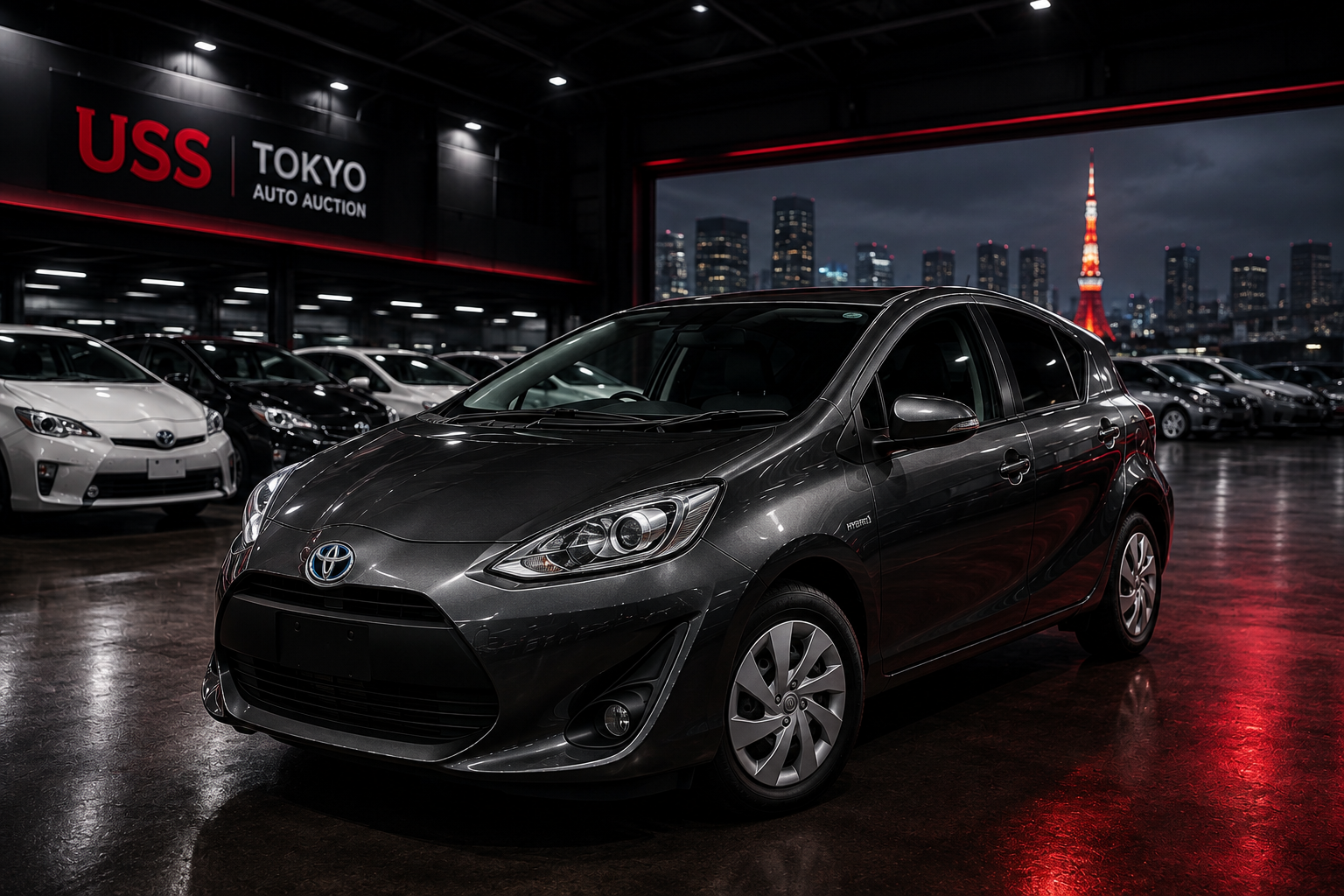
The honest summary: proximity to Tokyo lowers your logistics cost, not your purchase price. Both matter, but they are not the same thing.
The main Kanto venues:
Why Kanto stock tends to be good. Urban Japanese cars typically accumulate low annual mileage. Japan's shaken roadworthiness inspection regime forces regular maintenance. And unlike coastal or snow-region vehicles, Kanto cars have generally had limited exposure to road salt, which matters enormously for underbody corrosion.
The access problem. Overseas buyers cannot bid at these auctions directly. Membership requires a Japanese business entity and deposits. Everyone importing from Japan works through a licensed exporter or agent... the question is only which one, and how transparent they are.
Cheap and reliable are not the same thing. These models deliver both.
The default answer for most buyers. Enormous supply, a 1.5-litre hybrid system with a strong reliability record, and outstanding real-world economy. Sold as the Prius C in some markets. Older examples from around 2012 to 2015 sit at the affordable end, while later cars command more. If you want the lowest-risk cheap hybrid, start here.
Often the cheapest hybrid per unit of car you get. Supply is vast, the 1.8-litre system is proven, and space is genuinely usable. The caveat: many were used as taxis or corporate fleet vehicles, so verify mileage carefully and treat unusually high-mileage examples with caution.
Sensible, economical and underrated. The Fielder wagon in particular offers far more practicality than an Aqua at comparable money. Popular with buyers who need load space without moving up to a minivan.
Cheaper than the equivalent Aqua, often noticeably so. Know what you are buying: early Fit Hybrid models used a dual-clutch transmission that developed a mixed reputation. Later examples are better regarded. Research the specific generation before bidding.
The seven-seat Prius derivative. If you need seats and economy together, nothing else at this price does both.
Lower supply, but frequently good value precisely because fewer buyers search for them.
A note on the Nissan Note e-Power: technically a series hybrid, where the engine only generates electricity. Excellent in city traffic, though servicing knowledge in some markets is thinner.
What an Auction Sheet Tells You
The auction sheet is the most important document in this process. Learn to read it and you have most of what you need.
Overall grade runs on a numeric scale. Grade 4 and above indicates a solid car with only minor cosmetic issues. Grade 3.5 means visible wear that is usually still perfectly serviceable. Grade 3 and below means significant issues requiring inspection. R or RA denotes accident repair history, which is not automatically disqualifying but demands a much closer look.
Interior grade is scored separately, on a letter scale from A downward. This is where you learn about seat wear, stains, smoke damage and dashboard condition... details that photographs consistently flatter.
The condition map uses standardised symbols across the vehicle diagram. Scratches, dents, waves in panels, corrosion, and panels that have been replaced each carry their own marking. A car with several replacement markings has a history worth understanding before you commit.
Mileage is recorded, and importantly the sheet flags when an odometer reading cannot be verified. Take that flag seriously.
What this means in practice: an auction sheet, properly translated, tells you more about a car's real condition than most in-person inspections of a cleaned and detailed vehicle on a dealer forecourt.
Here is the single most important thing in this guide, and it is something most exporter websites avoid saying.
Auction sheets do not grade hybrid battery health. There is no battery condition score. The grade tells you about bodywork, interior and mechanical condition generally, not about the state of health of the traction battery.
This matters because the battery is the most expensive component on the car, and its condition does not correlate neatly with mileage or age.
What can be checked before purchase:
What cannot be guaranteed: precise remaining battery life. Anyone claiming certainty is overselling.
The practical approach: budget realistically. Research battery replacement and reconditioning costs in your own market before you buy, because availability varies enormously by country. In markets with an established hybrid repair trade, replacement is a manageable expense. In markets without one, it can be prohibitive.
Ask your exporter directly whether hybrid diagnostic checks are included in pre-shipment inspection. If the answer is vague, that itself is information.
The auction price is the beginning of the number, not the end.
| Cost component | What it covers |
| Hammer price | Your winning bid at auction |
| Auction fees | Charged by the auction house |
| Agent or exporter fee | Sourcing, bidding and coordination |
| Deregistration | Cancelling Japanese registration, issuing the export certificate |
| Inland transport | Auction venue to port... lowest from Kanto venues |
| Pre-shipment inspection | Where your country requires it |
| Ocean freight | RoRo or container to your destination port |
| Marine insurance | Optional but strongly advisable |
| Destination duties and taxes | Frequently the largest single item |
| Clearing and port charges | At your end |
On price expectations: used hybrids such as the Prius and Aqua are frequently available under ¥1.5 million in the Japanese market, with older, higher-mileage examples sitting well below that. Exporter FOB listings typically run above auction hammer prices, since they include acquisition costs and margin.
The item that catches people out is destination duty. In several markets, import duties and taxes exceed the cost of the car itself. Work out your landed cost before you fall in love with a listing, not after.
Do this before anything else. It determines which cars you can even consider.
Vehicle age limits. Many countries cap the age of importable used vehicles... commonly between five and ten years, though the specifics vary widely and change by notification. Some have no limit at all.
Steering configuration. Japanese domestic vehicles are right-hand drive. Countries requiring left-hand drive either prohibit these imports or require conversion, which is expensive and sometimes not permitted.
Emission standards. Some destinations require compliance with specific emission tiers, which effectively sets a minimum model year.
Pre-shipment inspection. Numerous countries mandate inspection by an approved agency in Japan before shipment, covering roadworthiness and sometimes radiation screening. This must be arranged before the vessel sails, not afterwards.
Documentation. Expect to need the export certificate with translation, bill of lading, and commercial invoice at minimum. Your customs authority may require more.
One sentence worth remembering: a car that cannot legally enter your country is not a bargain at any price.
1. Confirm your import rules. Age limit, steering, emissions, inspection requirements.
2. Set a landed budget, not a car budget. Work backwards from what you can spend at your own port.
3. Choose your exporter. Ask whether they hold auction membership directly, whether they translate auction sheets in full, and whether hybrid diagnostic checks form part of their inspection.
4. Specify what you want. Model, year range, maximum mileage, minimum auction grade, interior grade, and whether repair history is acceptable.
5. Review sheets before bidding. You should see the translated auction sheet and set your own maximum. Never bid on photographs alone.
6. Win and confirm. Payment terms, deregistration and export certification follow.
7. Inspection and shipping. Pre-shipment inspection where required, then vessel booking.
8. Clear at your end. Documentation should reach you before the vessel does.
Q1. What is the cheapest hybrid car to buy from Japan? The Toyota Aqua and older Toyota Prius models are generally the most affordable reliable hybrids, with used examples of both frequently available under ¥1.5 million in Japan and older, higher-mileage cars costing considerably less.
Q2. Can I bid at Japanese car auctions myself? No. Auction membership requires a registered Japanese business entity and deposits. Overseas buyers work through a licensed exporter or agent who bids on their behalf.
Q3. How do I check hybrid battery health before buying? You cannot verify it fully from an auction sheet, because battery condition is not graded. Ask your exporter to arrange diagnostic checks during pre-shipment inspection, and review service history for any prior battery replacement.
Q4. Are cars near Tokyo cheaper than elsewhere in Japan? Not usually at the hammer. Kanto auctions have the highest volume and strong competition, so prices are often firm. The real advantage is lower inland transport cost to Yokohama, Kawasaki and Tokyo ports.
Q5. What auction grade should I look for? Grade 4 and above for a car with only minor cosmetic issues. Grade 3.5 is often good value with visible wear. Below grade 3, or on any car marked R or RA for repair history, inspect thoroughly before bidding.
Q6. How long does shipping take from Japan? It depends entirely on destination. Regional Asian ports can be two to three weeks; Africa, Europe and the Americas run considerably longer. Your exporter should confirm transit time before you commit.
Q7. Do I need a pre-shipment inspection? That depends on your country. Many destinations mandate inspection by an approved agency in Japan before shipment. Confirm your own requirement early, because it must be arranged before the vessel sails.
The Nobuko Japan Vehicle Sourcing Team has 14 years of experience working with Japanese used vehicles, auction information, vehicle sourcing and international buyers.
The team bids across Kanto and national auction venues for hybrid vehicles, and works with hybrid-specific pre-export checks, mileage verification, interior and exterior grading, and the destination import requirements that determine which vehicles are eligible for each buyer's market.
The team works with Japanese auction sheets, auction grades, mileage information, vehicle condition reports and sourcing requirements when evaluating used vehicles for export. This guide combines practical Japanese vehicle sourcing experience with a structured approach to auction sheet interpretation and verification.
Source Your Hybrid from the Auction Floor, Not a Listing Page
The difference between a cheap hybrid and a costly one is what you knew before you bid. Working with an exporter who holds direct auction access means you see the translated grading sheet, the panel-by-panel condition map and the verified mileage in advance and you set your own maximum rather than accepting whatever stock is already sitting on a lot.
Nobuko Japan bids across Kanto and national auction venues, translates the full auction sheet, carries out a 200-point inspection including hybrid system checks, and handles deregistration, export documentation and shipping to your port.
For Latest updates
The Pakistani car market is constantly changing. In fact, sedan cars have been dominating the roads ...
Toyota Yaris Sedan is one of the major vehicles in the Toyota portfolio across the globe. This provi...
The Toyota Raize has gained popularity within the Pakistani roads since this mini-SUV resonates stro...
Considering the purchase of a new automobile in Pakistan? The traffic is heavy, the cost of gas is n...
Check out other articles related to Buying Guides.
Is the Toyota Raize the Perfect Small SUV for Pakistani Families?