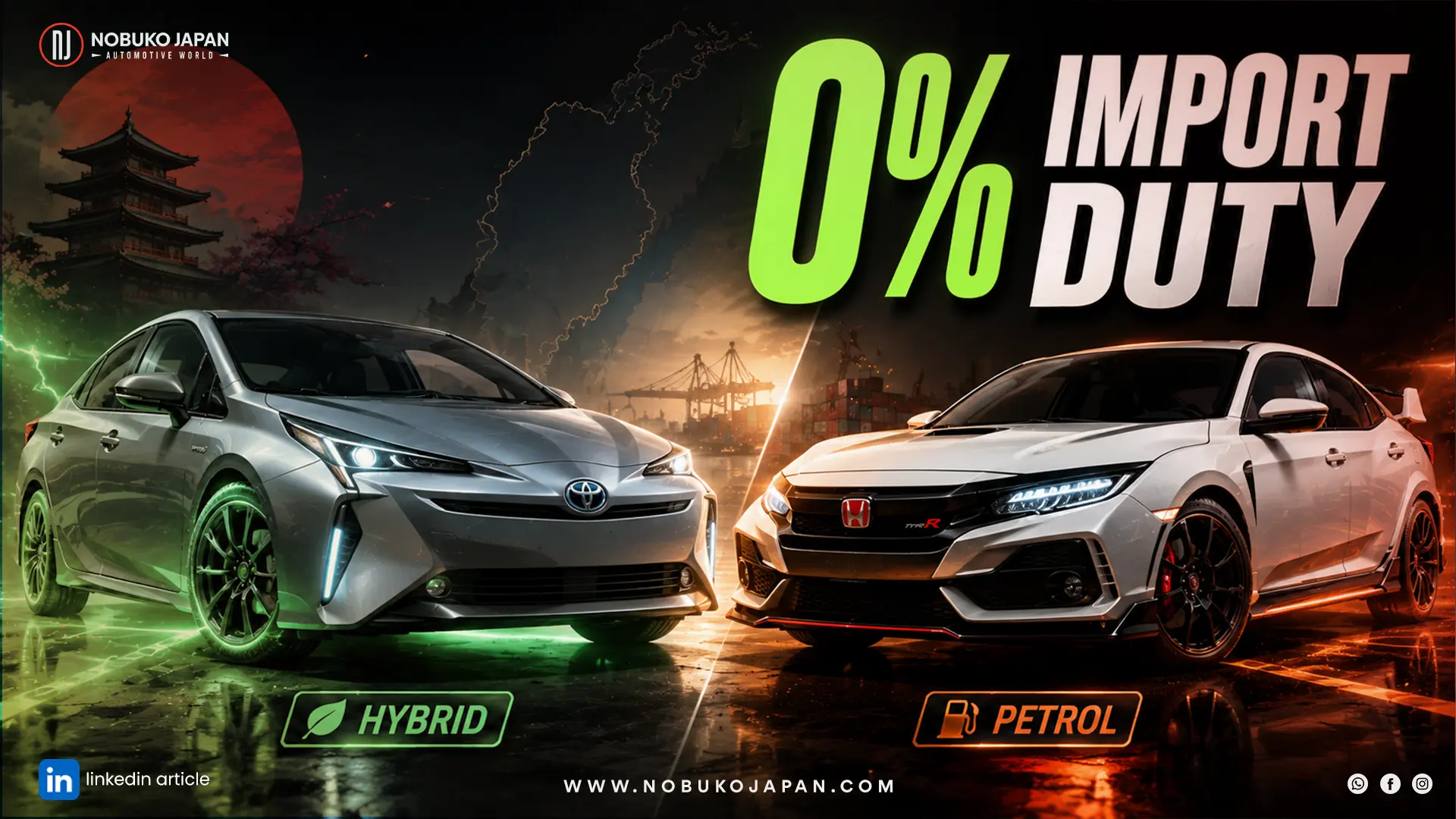
EU-Japan EPA, VRT guide, NCTS process, real costs, and hybrid vs petrol comparison
By Nobuko Japan Import Team | Updated: April 2026 | 100+ Irish imports handled since 2014
Revenue Commissioners Verified | EU-Japan EPA Compliant | NCTS Process Referenced | RSA Registration Guide
| From February 2026, cars manufactured in Japan qualify for 0% customs duty in Ireland under the EU-Japan Economic Partnership Agreement (EPA). To import a car from Japan to Ireland: buy at a Japanese auction (USS, TAA, or JU Net), ship via RoRo to Dublin Port or Cork, pay 0% customs duty with a valid Certificate of Origin, pay 23% VAT to Irish Revenue Commissioners on the CIF value, pay VRT at an NCTS centre based on CO2 emissions and OMSP, fit E-mark certified tyres, and register with the Road Safety Authority (RSA). Total timeline is 8 to 14 weeks. VRT is the largest variable cost, running from 7% for hybrids to 41% for high-emission vehicles. |
The EU-Japan Economic Partnership Agreement (EPA), which Ireland benefits from as an EU member state, removes customs duty on cars manufactured in Japan. From February 2026, the duty rate dropped from 10% to 0% for qualifying vehicles.
To qualify: the car must be manufactured in Japan. Toyota, Honda, Nissan, Mazda, Subaru, and Suzuki models built in Japan all qualify. European cars sold in Japan and re-exported, such as a German-built BMW, still pay the standard 10% EU duty.
CRITICAL: CERTIFICATE OF ORIGIN REQUIRED You must present a valid Certificate of Origin at Irish customs to claim the 0% duty rate. Without it, Irish Revenue Commissioners apply the default 10% duty. On a €6,000 CIF value, that is €600 you did not need to pay. Nobuko Japan includes the Certificate of Origin with every shipment as standard. |
The Japanese yen has depreciated approximately 30% against the euro over the past five years. For Irish buyers, this means your euro buys significantly more car at Japanese auction than it did in 2019 or 2020. A car that cost the equivalent of €7,000 five years ago now costs closer to €5,000 at the same quality level.
Japanese drivers average 5,000 to 7,000 km per year versus 15,000 to 18,000 km for Irish drivers. Japanese roads use less salt in winter than Irish roads. A 10-year-old Japanese car typically shows less corrosion and lower mileage than a 5-year-old Irish car from a coastal county.
This table shows the full landed cost from Japan auction to Irish road. VRT is the largest variable and depends on your car's CO2 emissions and OMSP.
| Cost Item | Rate | Example (€5,000 car) |
| Auction purchase price | N/A | €5,000 |
| RoRo shipping (Japan to Dublin Port) | N/A | €1,000 |
| Marine insurance | N/A | €100 |
| Customs duty (EU-Japan EPA 2026) | 0% | €0 |
| Import VAT (Irish Revenue) | 23% on CIF | €1,380 |
| Customs agent + Dublin Port fees | Fixed | €250 |
| VRT (Revenue Commissioners) | 7 to 41% on OMSP | €400 to €2,000 |
| NCTS inspection fee | Fixed | €55 to €90 |
| New E-mark tyres (if needed) | N/A | €300 to €600 |
| Total landed cost (estimate) | €8,000 to €10,000 |
WHAT IS CIF VALUE? CIF stands for Cost, Insurance, and Freight. It is the combined total of your auction purchase price, marine insurance, and RoRo shipping cost. Irish Revenue Commissioners calculate both customs duty and import VAT on this figure. |

Japanese auction houses USS, TAA, and JU Net grade every car before sale. The sheet documents every scratch, dent, repair, and mechanical note. Grade alone is not enough: always request the full translated auction sheet.
| Grade | Condition | Import It? | Interior Grade |
| 5 | Near showroom, no defects | Yes, premium pick | A or B |
| 4.5 | Excellent, minor surface marks only | Yes, best value | A or B |
| 4 | Good, small scratches or dents noted | Yes, solid choice | B or C |
| 3.5 | Average, visible marks, no structural issues | Minimum recommended | C |
| R | Repaired damage. Check sheet for what was fixed. | Check details first | Varies |
| 1 to 2 | Poor condition, avoid | No | D or E |
NOBUKO JAPAN PRACTICE We translate every auction sheet into English before you bid. Grade 4 or 4.5 is our standard recommendation for Irish imports. Grade R cars are not automatically rejected: a replaced windscreen or door panel at Japanese repair standards is acceptable. We identify what was repaired and advise accordingly. |
From auction win to Irish road, here is every step with timeline and key documents.
| # | Step | Timeline | Key Entity / Document |
| 1 | Set budget including all landed costs | Before bidding | Full cost calculator |
| 2 | Bid at USS, TAA, or JU Net auction via agent | Day 1 | Auction sheet (translated) |
| 3 | Pay auction price and agent deposit | Within 3 days | Commercial invoice |
| 4 | Japanese deregistration and export cert issued | Week 1 to 2 | Japanese export certificate |
| 5 | Certificate of Origin obtained for EU-Japan EPA claim | Week 1 to 2 | Certificate of Origin (critical) |
| 6 | RoRo vessel booking and port loading in Japan | Week 2 to 3 | Bill of Lading |
| 7 | RoRo sea freight to Dublin Port or Cork | Week 3 to 8 | Marine insurance policy |
| 8 | Irish customs clearance, 0% duty claim, VAT payment | Week 8 to 9 | SAD (Single Administrative Document) |
| 9 | NCTS appointment: VRT assessment and payment | Week 9 to 11 | Revenue Commissioners OMSP valuation |
| 10 | Fit E-mark tyres if Japanese tyres still fitted | Before NCTS | E-mark certification (ECE Regulation 30) |
| 11 | RSA vehicle registration and Irish plates issued | Week 11 to 13 | Road Safety Authority (RSA) |
| 12 | Insurance and motor tax arranged, car on Irish road | Week 12 to 14 | Specialist insurer, Revenue motor tax |
RoRo is the standard method for single car imports from Japan to Ireland. The car drives onto the vessel in Japan and drives off at Dublin Port or Port of Cork. Cost runs €800 to €1,400 depending on vessel and season. Transit time is 4 to 6 weeks.
Container shipping suits classic cars, multiple vehicles, or buyers who want to include personal items. Cost is higher at €1,500 to €2,500 for a 20ft container. Transit time is similar but loading and unloading adds 1 to 2 weeks.
| Factor | RoRo | Container |
| Cost | €800 to €1,400 | €1,500 to €2,500 |
| Transit time | 4 to 6 weeks | 5 to 7 weeks |
| Best for | Single cars, standard imports | Classic cars, multiple vehicles |
| Personal items allowed | No | Yes |
Your car arrives at Dublin Port or Cork. A customs agent files the Single Administrative Document (SAD) with Irish Revenue Commissioners. This is where you pay duty and VAT.
Vehicle Registration Tax (VRT) is paid to Irish Revenue Commissioners at an NCTS centre before the car receives Irish registration plates. It is calculated on two factors: the car's Open Market Selling Price (OMSP) in Ireland and its CO2 emissions.
The Open Market Selling Price is the price Revenue Commissioners believe the car would sell for in Ireland on the open market. Revenue sets this figure, not the buyer. It is not the same as what you paid at auction in Japan.
Revenue uses their own OMSP database. If you believe their valuation is too high, you can challenge it using a professional valuation report from an approved VRT valuation service. A successful challenge reduces your VRT bill.
These are Irish Revenue Commissioners VRT bands for Category A passenger cars.
| CO2 Emissions (g/km) | VRT Rate | Minimum Charge |
| 0 to 50 (Electric / Hybrid) | 7% | €140 |
| 51 to 80 | 9% | €180 |
| 81 to 90 | 9.75 to 10.5% | €195 to €210 |
| 91 to 100 | 11.25 to 12% | €225 to €240 |
| 101 to 110 | 12.75 to 13.5% | €255 to €270 |
| 111 to 130 | 15.25 to 17.5% | €305 to €350 |
| 131 to 150 | 19.25 to 23% | €385 to €460 |
| 151 to 170 | 25.5 to 28% | €510 to €560 |
| 171 to 190 | 34% | €680 |
| 191 and above | 41% | €820 |
Here is what VRT looks like on the most commonly imported Japanese cars to Ireland.
| Model | CO2 g/km | VRT Rate | OMSP Example | VRT Amount |
| Toyota Aqua (Prius C) Hybrid | 79 | 9% | €8,000 | €720 |
| Honda N-Box (petrol) | 118 | 15.25% | €7,000 | €1,068 |
| Toyota Voxy Hybrid | 121 | 16.75% | €9,500 | €1,591 |
| Toyota Vitz (petrol) | 98 | 12% | €6,500 | €780 |
| Mazda Demio (petrol) | 105 | 12.75% | €7,000 | €893 |
| Toyota Alphard (petrol) | 196 | 41% | €18,000 | €7,380 |
TOYOTA ALPHARD WARNING FOR IRELAND The Toyota Alphard emits approximately 196g/km CO2. This puts it in the 41% VRT band. On an OMSP of €18,000, VRT alone is €7,380. Combined with VAT and shipping, the Alphard is significantly more expensive to land in Ireland than in the UK. Buyers considering the Alphard should calculate the full Irish landed cost carefully before purchasing. |
Irish Revenue charges a NOx levy on diesel vehicles based on nitrogen oxide emissions measured in mg/km. This levy applies in addition to VRT.
Most Japanese diesel imports are older commercial vehicles. For standard Irish passenger car imports, petrol and hybrid models are strongly preferable because they avoid the NOx levy entirely.
Electric vehicles with an OMSP up to €40,000 pay €0 VRT until 31 December 2026. EVs with OMSP between €40,000 and €50,000 receive partial relief of up to €5,000 off VRT. Japanese electric imports such as the Nissan Leaf (older models) benefit significantly from this relief.
Ireland's VRT system heavily rewards low CO2 emissions. Hybrid Japanese imports pay significantly less VRT and lower annual motor tax than petrol equivalents. This is an Ireland-specific advantage that UK buyers do not have in the same way.
| Factor | Toyota Aqua Hybrid (79g/km) | Toyota Vitz Petrol (98g/km) |
| CO2 emissions | 79g/km | 98g/km |
| VRT rate | 9% | 12% |
| VRT on €8,000 OMSP | €720 | €960 |
| Annual motor tax | €170 (Band B) | €390 (Band C) |
| Real world fuel economy | 55 to 65 mpg | 40 to 50 mpg |
| EV VRT relief (to Dec 2026) | Partial relief applies | None |
| NOx levy | Not applicable | Not applicable (petrol) |
| 5-year running cost saving | €1,500 to €2,500 vs petrol | Baseline |
Over five years, a Toyota Aqua hybrid buyer saves approximately €1,500 to €2,500 in VRT and motor tax versus a Toyota Vitz petrol buyer, before factoring in fuel savings. For Irish buyers, the hybrid premium at Japanese auction pays back within 18 to 24 months.
BEST JAPANESE HYBRID IMPORTS FOR IRELAND Toyota Aqua (Prius C): 79g/km, 9% VRT, most popular hybrid import. Toyota Voxy Hybrid: 121g/km, 16.75% VRT, family 7-seater. Honda Fit Hybrid: 104g/km, 12.75% VRT, compact and reliable. Nissan Note e-Power: 87g/km, 9.75% VRT, good city car. All four are available at USS, TAA, and JU Net auctions. |
After customs clearance, you book an appointment at your nearest National Car Testing Service (NCTS) centre. Ireland has NCTS centres in Dublin, Cork, Limerick, Galway, Waterford, and other locations.
Japanese market tyres are not fitted with European E-mark certification (ECE Regulation 30). Irish roads require E-mark tyres. Your car will fail NCTS inspection if Japanese tyres are still fitted. Budget €300 to €600 for a full set of E-marked replacement tyres before your appointment.
| Document | Issued By | Purpose |
| Japanese export certificate | Japanese government | Proves permanent export from Japan |
| Certificate of Origin | Shipping agent / exporter | Claims 0% duty under EU-Japan EPA |
| Bill of Lading | RoRo shipping line | Proves direct Japan to Ireland shipment |
| Commercial invoice | Seller / auction house | Shows CIF value for VAT calculation |
| SAD (Single Administrative Document) | Irish customs agent | Customs clearance confirmation |
| Proof of VAT payment | Irish Revenue Commissioners | Required for NCTS VRT appointment |
| Cost Component | Irish Dealer (Ford Fiesta) | Japan Import (Toyota Vitz) |
| Purchase price | €9,000 | €3,200 (USS auction) |
| RoRo shipping to Dublin Port | N/A | €1,000 |
| Customs duty (EU-Japan EPA) | N/A | €0 |
| Import VAT at 23% | Included in price | €966 |
| Agent and Dublin Port fees | N/A | €250 |
| VRT (98g/km CO2, 12% on OMSP) | N/A | €420 |
| E-mark tyres | N/A | €350 |
| Total cost | €9,000 | €6,186 |
| Mileage | 90,000 km | 45,000 km |
| Saving by importing | €2,814 |
His verdict: I nearly bought the Ford Fiesta locally. The Vitz had half the kilometres and cost me €3,000 less. I will import my next car too.
No. Japanese-manufactured cars pay 0% customs duty under the EU-Japan EPA from February 2026. A valid Certificate of Origin is required to claim this rate. Without it, Revenue applies the standard 10% EU duty.
VRT is calculated as a percentage of the car's Irish OMSP (Open Market Selling Price) based on CO2 emissions. Rates run from 7% for cars under 50g/km to 41% for cars over 191g/km. Revenue sets the OMSP; you can challenge it with a professional valuation.
The National Car Testing Service (NCTS) inspection is where you pay VRT and have the car's VIN, mileage, and emissions verified. Japanese tyres without E-mark certification will fail. Book after customs clearance, not before.
8 to 14 weeks from auction win to Irish road. RoRo sea freight takes 4 to 6 weeks. Customs, NCTS, and RSA registration add 2 to 4 weeks after arrival at Dublin Port or Cork.
Six documents: Japanese export certificate, Certificate of Origin, Bill of Lading, commercial invoice, SAD (customs clearance), and proof of VAT payment. The Certificate of Origin is critical for the 0% duty claim.
Yes. Lower CO2 emissions mean lower VRT rates and lower annual motor tax. A Toyota Aqua hybrid pays 9% VRT versus 12% for a petrol Toyota Vitz. Over 5 years the saving in VRT and motor tax runs €1,500 to €2,500 before fuel economy is included.
The NOx levy is an Irish Revenue charge on diesel vehicles based on nitrogen oxide emissions. It ranges from €100 to over €5,000. Petrol and hybrid Japanese imports are not subject to the NOx levy. Avoid diesel Japanese imports unless the levy has been calculated and is acceptable.
Yes but the cost is significantly higher than in the UK. The Alphard emits approximately 196g/km CO2, putting it in the 41% VRT band. On an OMSP of €18,000, VRT alone is €7,380. Calculate the full Irish landed cost before purchasing.
About This Guide
Written by the Nobuko Japan import team based on 100+ Irish import shipments handled since 2014. All tax rates are sourced from Irish Revenue Commissioners published VRT schedules and EU-Japan EPA official documentation. NCTS process references are drawn from NCTS Ireland official guidance. RoRo shipping costs reflect 2025 to 2026 actual rates on Japan to Dublin Port routes. Last reviewed: April 2026.
For Latest updates
2026 Costs Breakdown: Importing a Japanese Car to UK, Ireland and CyprusImporting a Japanese vehicle...

Japan's reputation as makers of best Japanese cars; electric-proof, high-tech, and exciting automobi...
There is more to buying a car in Japan than the auction price. The final price comes as a great shoc...
.png)
Importing a car from Japan to the UK is an exciting process. However, understanding the shipping tim...
