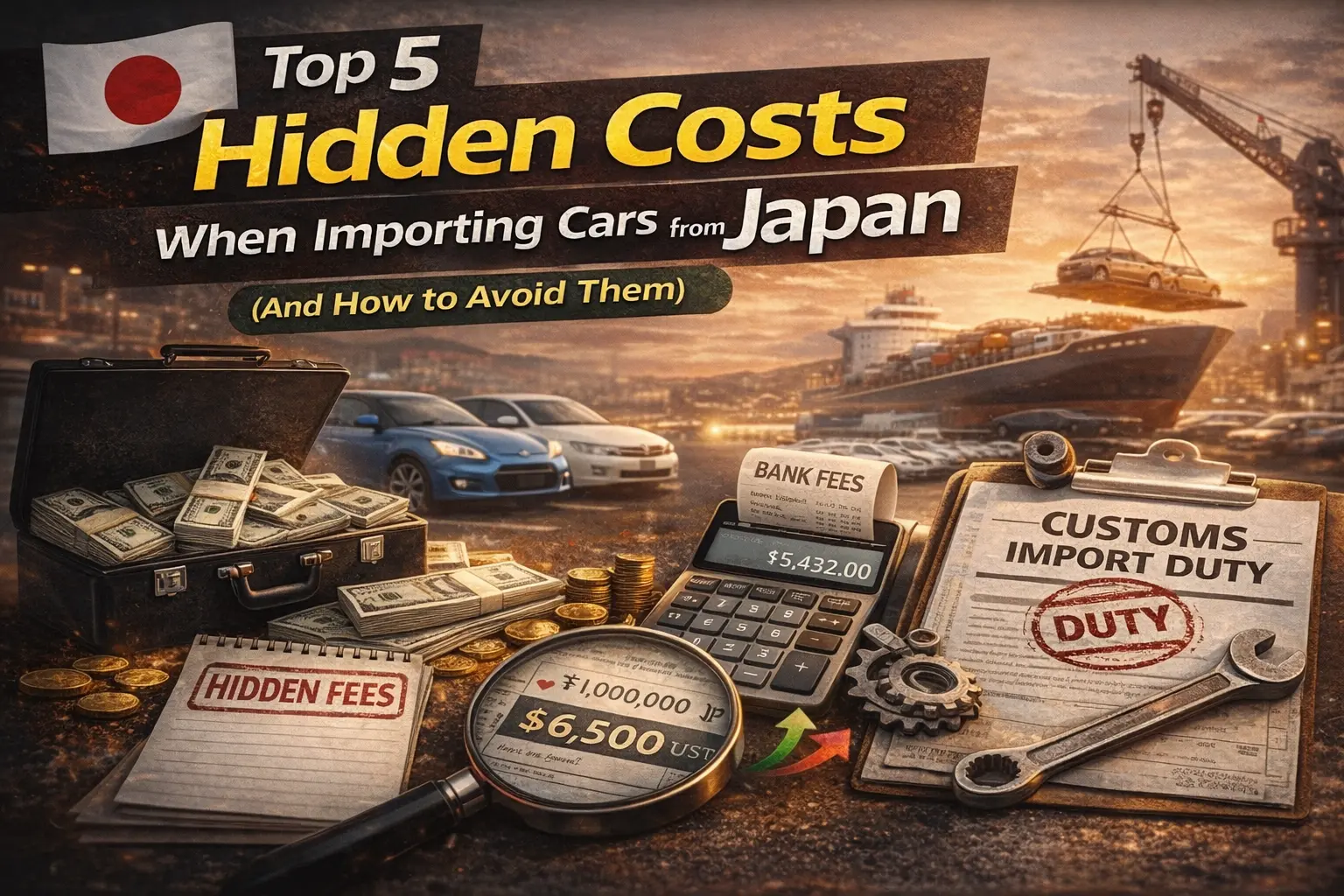
The Japanese car importation business can be very lucrative. The cars are usually of high-quality and low-mileage. However, hidden costs can quickly turn a good deal into a loss. Many first-time importers focus only on the auction price. They forget the other fees. This guide reveals the four most common hidden costs. We shall demonstrate to you what they are and how they can be avoided. You will be able to know how to save your profit and get your true cost by the end.
The cost to ship a car from Japan is not just the sea freight. This is the first and biggest surprise for new importers.
The Hidden Fees: You will get a basic "freight quote." But the final invoice often includes:
Terminal Handling Charges (THC): Fees at both the Japanese port (port of origin) and your destination port.
Bill of Lading Fee: The cost to issue the official shipping document.
Fuel Surcharge: This changes with global oil prices and is rarely fixed.
Customs Clearance Fees: In your country, a broker will charge to clear the car. This is separate from any import duty.
Ask for an "All-In" Quote: Demand a breakdown that includes EVERY foreseeable fee: freight, THC, documentation, and fuel surcharge.
Use a Reputable Forwarder: Work with a freight forwarder who specializes in auto imports from Japan. They understand the process and give clearer estimates.
Factor in Insurance: Maritime insurance (often 1.1% of the car's value) is non-negotiable. Include it in your initial budget.
Your car is not magically on the ship. It must be transported from the auction house to the export port. This is a separate cost inside Japan.
The Hidden Fees:
Auction Transport Fee: The cost to move the car from the auction to the port or storage yard.
Export Certificate (Deregistration): In Japan, the car must be de-registered for export. Your agent handles this, but they pay a government fee and charge you for the service.
Port Storage: If your car arrives at the port before the ship is ready, you may incur daily storage fees.
Clarify with Your Agent: Before you bid, ask your Japanese buying agent for a clear list of their FOB (Free on Board) fees. This should include auction transport, deregistration, and delivery to the port.
Consolidate Shipments: Shipping multiple cars at once is far more cost-effective. It reduces the per-unit cost of both domestic transport and sea freight.
When the car arrives, it must be legal to drive in your country. The costs to make it compliant are often underestimated.
The Hidden Fees:
Import Duty & Taxes: You must pay this to your government. The rate depends on your country and the car's engine size/age/value. Never guess this number.
Compliance Modifications: Your market may require changes. This can include headlights (for LHD countries), radio frequency compliance, speedometer conversion, or adding child restraint anchors.
Registration & Inspection: Your local road authority will charge for a safety inspection, emissions test, and new registration plates.
How to Avoid This Cost:
Research First: This is the most important step. Contact your local vehicle licensing authority. Get the official rules for importing your specific car model and year.
Get a Pre-Purchase Compliance Check: A local mechanic or compliance workshop can tell you exactly what a specific model needs to pass. Get this estimate before you buy.
Budget for the Worst-Case: When calculating your total landed cost, always use the highest possible duty rate and a realistic estimate for modifications.
Many importers forget that they're dealing in multiple currencies. The auction price is in Japanese Yen (JPY). Your money is likely in US Dollars, Euros, or Pounds. This creates a hidden risk.
The Hidden Cost: Exchange rates move daily. A favorable rate when you budget can turn against you by payment day. Banks and payment services also charge transfer fees and offer poor exchange margins, which is a hidden percentage loss on every transaction.
How to Mitigate This Cost:
Use a Specialist FX Service: Do not use your standard bank. Use a foreign exchange service that specializes in business transfers. They offer far better rates and lower, transparent fees.
Lock in a Rate (Hedging): For large, planned purchases, you can "lock in" an exchange rate with your provider for a set period. This protects you from market swings.
Budget a Buffer: Always add a 2-3% buffer to your currency conversion calculations to cover minor fluctuations and fees.
You buy the car "as-is" from auction. Even with a perfect grade sheet, a car that has sat or been in transit can reveal issues.
The Hidden Cost: When the car lands, you may find:
A dead battery from weeks in a shipping container.
Flat-spotted tires from being stationary.
Minor fluid leaks that developed in transit.
Surprises the auction inspector missed.
These mean immediate repair costs before you can even offer the car for sale.
Create a Reconditioning Fund: Build a standard fee into your total cost calculation anywhere from $200 to $800 per car for immediate landing costs: deep clean, battery check/charge, basic fluids, and safety inspection.
Have a Local Mechanic Ready: Build a relationship with a trusted local workshop near your port of entry. They will be able to carry out a preliminary evaluation and simple recommissioning at a foreseeable price.
Inspect Thoroughly and Immediately: The moment you take delivery, do a full inspection. Determine the damage that might have taken place during shipping (take pictures in case of a claim against insurance) and mechanical requirements.
The true skill in importing isn't just picking great cars. It's in managing the entire financial ecosystem around each vehicle. Before you bid, calculate your Total Landed Cost using this formula:
Auction Price + Agent Fee + FOB Fees + Sea Freight (All-In) + Insurance + Import Duty & Tax + Compliance Costs + Currency Buffer + Reconditioning Fund = Total Landed Cost
Only when you know this final number can you decide if a car is truly profitable.
Professional importers succeed because they anticipate and control these five cost areas: Shipping Logistics, Japanese FOB Fees, Destination Compliance, Currency Exchange, and Landing Repairs. They budget for them before the bid. They build relationships with experts; freight forwarders, FX specialists, and mechanics to keep these costs predictable.
Use this checklist as your pre-bid checklist requirement. When you turn these steps into a habit, you will get rid of the unexpected, and instead of the unexpected turning into a threat to your business, you will have it as a manageable and predictable component of your business. This is what will make the difference between a sustainable import operation and a dangerous gamble.
For Latest updates
Importing a Japanese vehicle into the UK, Ireland, or Cyprus in 2026 is a smart idea. It's excellent...

Japan's reputation as makers of best Japanese cars; electric-proof, high-tech, and exciting automobi...

There is more to buying a car in Japan than the auction price. The final price comes as a great shoc...
.png)
Importing a car from Japan to the UK is an exciting process. However, understanding the shipping tim...