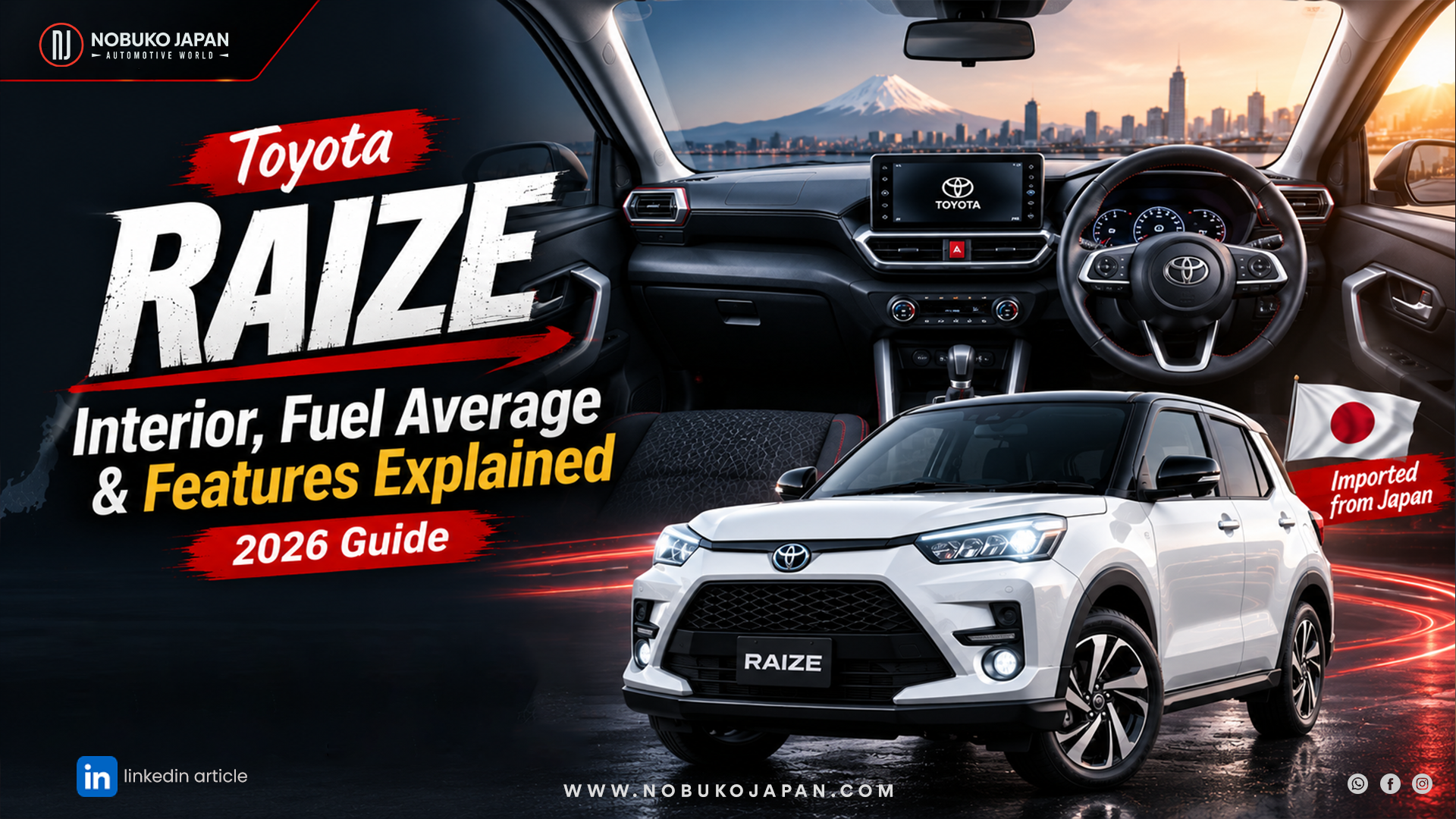
Spec sheets tell you the Toyota Raize has five seats and a 369-litre boot. They do not tell you that rear legroom gets tight past 5'8", that the infotainment unit arrives speaking Japanese, or that the boot has a movable floor most owners never discover.
This is the part of the buying decision that photographs cannot answer. You are choosing a car you will sit in for two hours a day in Karachi traffic, and the difference between a cabin that works and one that irritates comes down to details no listing mentions.
This guide covers the Toyota Raize interior in full: dashboard layout, seating and space, boot capacity, infotainment, safety equipment, engine performance, and the fuel average you can realistically expect on Pakistani roads rather than a Japanese test cycle.
Something worth clearing up first, because it trips up a lot of buyers comparing spec sheets online.
The Raize is built in two slightly different sizes. The Japanese domestic model measures 3,995mm long, 1,695mm wide and 1,620mm tall, deliberately kept under 4 metres to qualify for Japan's compact vehicle tax class. The Indonesian and Gulf versions are marginally larger at 4,030 × 1,710 × 1,635mm.
Pakistan imports JDM units. So if you are reading a spec page quoting 4,030mm, it is describing a car you are probably not buying.
Both share a 2,525mm wheelbase and roughly 185mm of ground clearance, so cabin space and road clearance are effectively identical.
The Raize dashboard is built around function rather than flourish, and it works better than the price suggests.
The layout is horizontal and low-set, which does two useful things: it keeps forward visibility excellent, and it makes the cabin feel wider than 1,695mm has any right to. Controls sit where your hand expects them. Climate controls are physical dials rather than buried in a touchscreen, which anyone who has fumbled through menus in traffic will appreciate.
Instrument cluster. Lower grades get conventional analogue dials with a small information display. The Z and hybrid grades receive a full digital cluster with configurable displays including drive mode, hybrid energy flow and fuel consumption.
Materials. Hard-wearing plastics dominate, as expected at this price. Panel fit is tight and consistent, and there are soft-touch inserts on higher grades. Nothing here feels premium, but nothing rattles either, which matters more over five years.
Storage. This is a genuine strength. Toyota fitted cubbies throughout... door bins sized for bottles, a deep centre console, smartphone slots, sunglass storage and additional trays. Daily usability is excellent.
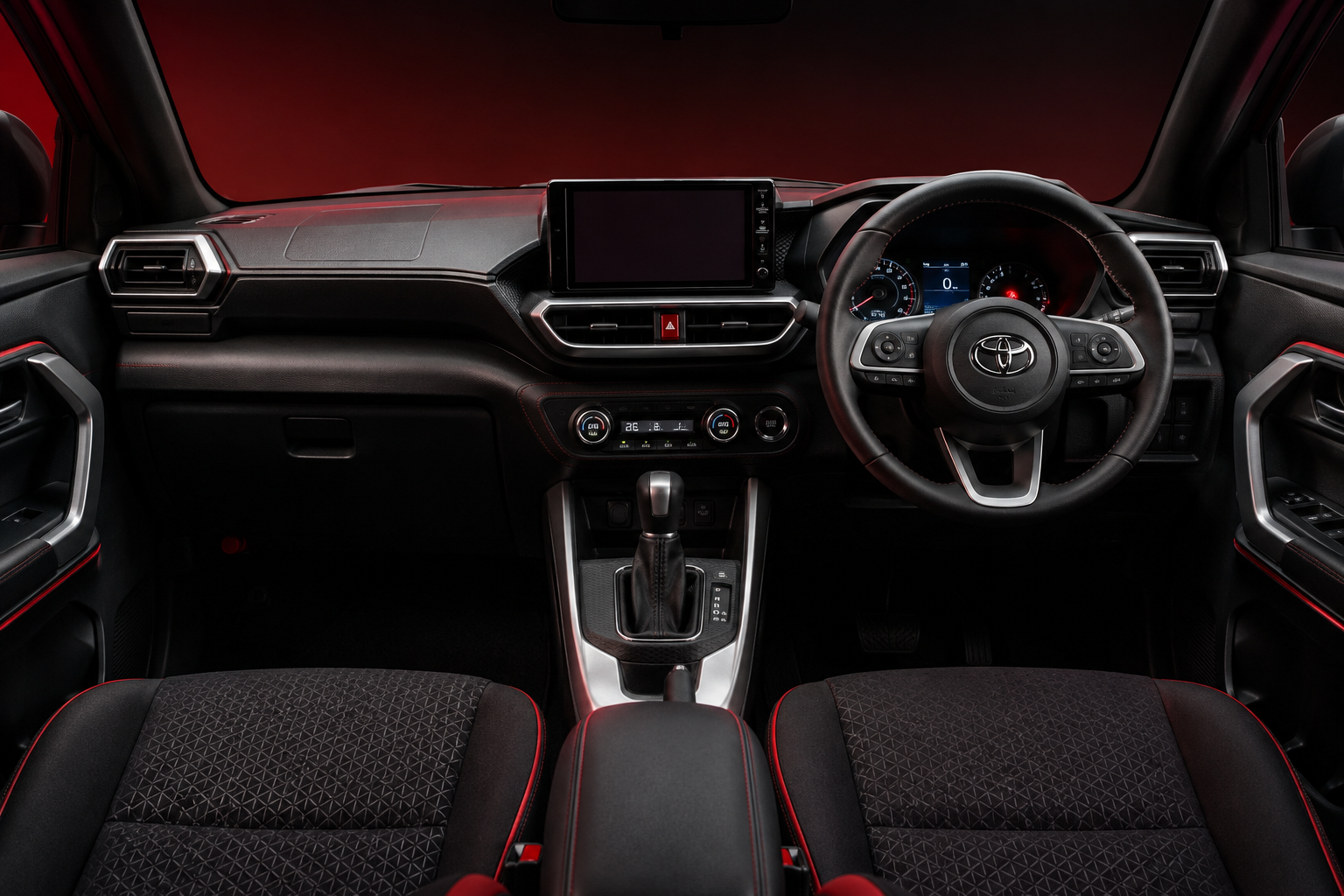
Comfortable and supportive for the segment, with a raised hip point that gives the elevated driving position crossover buyers want. Visibility is genuinely good in all directions... the low dashboard, upright windscreen and slim pillars combine to make city driving and parking easy. Two adults will be comfortable on a long drive.
Here is where honesty matters. Rear legroom measures roughly 730 to 750mm, which is adequate for children and average-height adults but gets tight for anyone over about 173cm, particularly behind a tall driver.
Headroom is the saving grace. The tall roofline delivers generous vertical space, so the cabin never feels claustrophobic even when legroom is snug.
Two omissions worth knowing about. Most Raize configurations lack a rear centre armrest with cup holders. And there are no dedicated rear air conditioning vents... ventilation reaches the back through small B-pillar outlets only. In a Lahore or Karachi summer with rear passengers, this is a real consideration rather than a minor niggle.
Realistic verdict: the Raize is a comfortable four-seater and an occasional five-seater.
The boot is one of the Raize's strongest arguments and one of its least understood features.
Capacity is 369 litres with the rear seats upright, which is competitive for a compact crossover and noticeably better than most subcompact hatchbacks. Fold the 60:40 split rear bench and capacity expands to roughly 1,100 litres.
The feature most owners miss: the Raize has a movable and removable deck board in the boot floor. Set it in the upper position and you get a flat load floor level with the folded seats. Drop it to the lower position and you unlock significantly more vertical depth for taller items. Remove it entirely and you gain maximum capacity.
Many Pakistani buyers use their Raize for months without realising the floor adjusts. If you already own one, check underneath the boot mat.
For weekly shopping, airport runs with two large suitcases, or weekend luggage for four, the Raize copes comfortably.
What ships from Japan. JDM Raize units come with a Japanese-market head unit running Japanese-language menus and Japanese navigation mapping. The navigation will not work in Pakistan. The radio tuner may not align with local frequency bands. Menus are frequently untranslatable through settings.
What owners do about it. Most replace the unit with an aftermarket Android head unit, which typically brings Apple CarPlay, Android Auto, working navigation, and English menus. Costs vary by market and unit quality but this is routine work in Karachi, Lahore and Islamabad.
What to check before buying. Ask whether the head unit has already been converted or replaced. A car with a proper English-language unit already fitted has saved you both money and a workshop trip. A car still running Japanese software has a cost attached that should factor into your negotiation.
Reversing cameras and 360-degree camera systems on higher grades generally continue working after a head unit swap, but confirm this with your installer.
Safety equipment varies significantly by grade, and this is where paying more genuinely buys something.
Standard across grades: dual front airbags, ABS with EBD, electronic stability control, and ISOFIX child seat anchors.
Toyota Safety Sense, fitted to Z and hybrid grades and some GR Sport units, adds:
Panoramic view monitor. Many higher-grade units carry a 360-degree camera system, which is genuinely useful given how tight Pakistani parking tends to be.
The important caveat: Japanese grade designations do not always match what a local listing claims. A car advertised as a "Z" may not carry the full safety suite. Verify against the auction sheet and the actual equipment list rather than the seller's description.
For a car in this price bracket, a Raize with Toyota Safety Sense offers safety technology that no locally assembled competitor at similar money can match.
The 996cc 1KR-VET turbocharged three-cylinder produces 98hp at 6,000rpm and 140Nm of torque from 2,400rpm, with a top speed of around 180 km/h.
Those numbers understate how it feels. The torque figure is the one that matters, and it arrives low enough that the Raize pulls cleanly from urban speeds without the CVT hunting for revs. In stop-start traffic it feels relaxed rather than strained, which is the opposite of what a one-litre engine usually delivers in a car this shape.
On the motorway, it cruises comfortably at legal speeds. Overtaking requires planning rather than confidence, and steep inclines with a full load will have the CVT working audibly.
Three-cylinder character is present. There is a distinctive thrum under acceleration that some drivers find characterful and others find intrusive. Take a test drive before deciding which camp you are in.
The naturally aspirated 1.2 is smoother but slower. The hybrid is the most refined of the three in city driving.
Manufacturer figures suggest around 17 km/l. Pakistani reality lands lower, as it always does.
| Condition | Realistic figure |
| Heavy city traffic, AC running | 11–13 km/l |
| Mixed city and suburban driving | 13–15 km/l |
| Motorway cruising at steady speed | 16–18 km/l |
| Hybrid grades, city driving | 17–20 km/l |
What moves the needle. The turbo rewards a light throttle and punishes a heavy one more sharply than a naturally aspirated engine, because boost costs fuel. Air conditioning through a Karachi summer will pull city figures towards the bottom of the range. Tyre pressure and the quality of fuel you use both make a measurable difference.
Fuel tank capacity is 36 litres, which at 14 km/l gives a realistic range of around 500km between fills.
Honest context: a hybrid hatchback will beat these numbers. But among crossovers with 185mm of ground clearance and five seats, the Raize is among the most economical things you can buy in Pakistan.
Worth stating plainly, because a comparison that only lists strengths is not useful.
None of these are dealbreakers at the price. But if you regularly carry adult rear passengers in summer heat, the ventilation limitation deserves serious thought before you commit.
It suits you if: you drive mostly with one or two people aboard, you want a high seating position and good visibility in traffic, you value boot space over rear legroom, you need ground clearance for broken roads, and you want modern safety technology at a price locally assembled cars cannot match.
It suits you less if: you regularly carry four adults, rear passenger comfort in summer is a priority, or you want a plush cabin with soft materials throughout.
The Raize is a well-judged compact crossover that makes intelligent compromises. It gives you space where a small SUV buyer actually needs it... boot, headroom, ground clearance, visibility... and takes it from where most owners will not notice.
Q1. How good is the Toyota Raize interior?
Practical rather than luxurious. Excellent storage, strong visibility, a sensibly laid out dashboard and good build quality, with hard plastics and limited rear amenities reflecting the price point.
Q2. What is the Toyota Raize boot space?
369 litres with the rear seats upright, expanding to roughly 1,100 litres with the 60:40 bench folded. A movable deck board lets you configure the load floor for height or flatness.
Q3. What is the Toyota Raize fuel average in Pakistan?
Expect 11 to 13 km/l in heavy city traffic, 13 to 15 km/l mixed, and 16 to 18 km/l on the motorway. Hybrid grades reach 17 to 20 km/l in the city.
Q4. Does the Toyota Raize have a sunroof?
No. The Raize is not offered with a sunroof in any grade.
Q5. Does the Toyota Raize have rear AC vents?
No dedicated rear vents. Air reaches rear passengers through small B-pillar outlets only, which is worth considering in Pakistani summers.
Q6. Will the Toyota Raize infotainment work in Pakistan?
Not as imported. JDM units run Japanese-language software with Japanese navigation that does not function locally. Most owners fit an aftermarket Android head unit with CarPlay and Android Auto.
Q7. What safety features does the Toyota Raize have?
All grades carry dual airbags, ABS with EBD and stability control. Z and hybrid grades add Toyota Safety Sense with pre-collision braking, adaptive cruise control and lane departure warning.
Q8. Is the Toyota Raize engine powerful enough?
The 996cc turbo produces 98hp and 140Nm from 2,400rpm, which is more than adequate for city driving and comfortable motorway cruising. Overtaking requires planning.
Interior condition is the hardest thing to judge from a listing photograph and the easiest thing to verify from an auction sheet. Japanese auction grading scores the cabin separately from the exterior, so you know about worn seats, damaged trim or a replaced head unit before you bid rather than after the car lands in Karachi.
Nobuko Japan translates the full auction sheet, carries out a 200-point inspection covering interior condition, and handles export documentation and shipping to Pakistan.
For Latest updates

The Japanese car auction market is continuously evolving with time. They offer buyers worldwide acce...

Japanese brands are the smart choice when you need a reliable car. In fact, companies like Toyota an...

Cost Breakdown of Importing a VehicleThinking about importing a car? Then you're at the right place....
.webp)
Why the Toyota Alphard is Gaining Popularity in the UKThe Toyota Alphard car has literally taken the...
Check out other articles related to Market trend.