
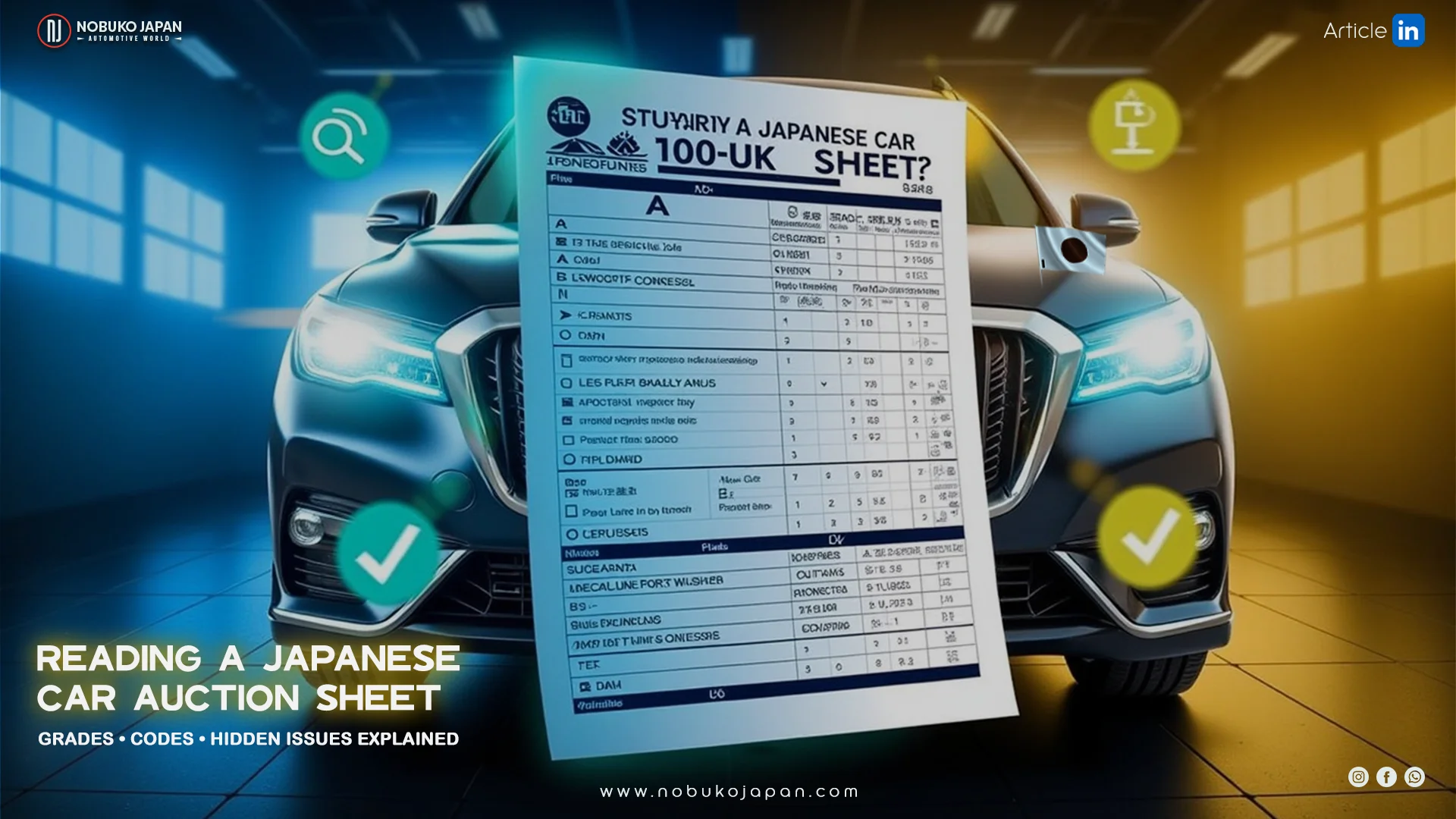
The Japanese auction grade is your most critical piece of buying information. It is a standardized code that summarizes a car's condition. Misunderstanding a grade can cost you thousands in unexpected repairs. This guide explains the entire grading system. We will discuss everything; from the common numbers to the special letter grades. Use this to make informed bids and avoid bad purchases.
This is the core of the system. Inspectors assign a grade based on the vehicle's exterior, interior, and mechanical condition.
Grade 6 (Roku): A practically new car. Extremely low mileage, no faults. Interior is flawless, exterior has no scratches or dents. Often ex-fleet or single-owner cars. Expect to pay top price.
Grade 5.5 (Go-Ten-Go): Excellent condition. May have one or two tiny imperfections (e.g., a pinhead-sized chip). Wear is minimal. This is a high-quality vehicle for retail.
Grade 5 (Go): Very good condition. Shows light, typical wear for its age and mileage. May have a few minor scratches (K2) or small dents (B2) that are hard to see. A reliable, clean wholesale car.
Grade 4.5 (Yon-Ten-Go): Good condition. Has noticeable but acceptable wear. May have several light scratches or a couple of larger dents clearly marked on the sheet. Paintwork is generally sound. This is the most common grade for quality used imports.
Grade 4 (Yon): Average condition for age. Will show clear signs of use: multiple scratches, door dings, slight interior wear. All issues are cataloged. Needs cosmetic reconditioning but should be mechanically sound. Represents strong value.
Grade 3.5 (San-Ten-Go): Fair condition. Wear is evident and significant. Could have larger repaired areas (H), faded paint, or noticeable interior wear. Requires careful inspection of the comments. Can be a value buy if flaws are purely cosmetic.
Grade 3 (San): Poor condition. Extensive cosmetic issues and may have minor mechanical faults (e.g., worn tires, noisy brakes). Often a high-mileage car. Only for buyers who can handle repairs.
Grades 2, 1, 0 (Ni, Ichi, Zero): Damaged vehicles. Grade 2 has major issues. Grades 1 and 0 are severely damaged, possibly from accidents, floods, or rust. Only for salvage or parts specialists.
These prefixes and suffixes modify the number grade, giving crucial extra information.
R, RA, RB, RC: The car has undergone significant repair. "R" alone is the best of this category, indicating professional repair that may be hard to detect. RA, RB, RC indicate progressively more extensive or noticeable repairs. A Grade 4R is a repaired car brought back to a Grade 4 standard. Always require detailed photos of any R-grade car.
A (Auction): This does not mean "Excellent." It often signifies a car that is non-standard for the Japanese market. Common examples: American specification (US-spec) cars imported to Japan, European models, or cars with significant modifications. Can be a good find but research it carefully.
S (Special): A rare premium grade. Reserved for low-mileage, pristine, often high-spec or desirable models. Think of a garage-kept Toyota Supra or Nissan Skyline GT-R. Commands the highest prices.
Any grade with a *** (e.g., 3*, 4.5*, R*): The car has a mechanical fault and is not running or driving properly. The grade reflects the body condition only. The fault could be minor (dead battery) or major (seized engine). Never buy a starred car without a full explanation of the fault from your agent.
Never Trust the Grade Alone. The grade is a summary. The auction sheet comments are the details. A Grade 4 with "HR" (rust) is worse than a Grade 3.5 with only "K2" (light scratches).
Match the Grade to Your Business Model.
For Retail: Target Grades 4, 4.5, and 5. They need the least work and appeal to customers.
For Wholesale/Flip: Grades 3.5 and 4 can offer the best margin if you can handle cosmetic fixes.
For Projects/Salvage: Only consider Grades R, 2, 1, 0, or * cars if you have repair expertise.
Consider "W" and "X" Codes. A Grade 4.5 with "XA/C" (broken A/C) in a hot market is a problem. A Grade 4 with "W" (needs work) may need a simple, cheap fix.
Factor in Reconditioning Cost. Immediately subtract estimated repair costs from your potential profit. A cheap Grade 3 that needs $2,000 in bodywork is not a bargain.
Not all auction houses grade with the same strictness. A Grade 4.5 from a notoriously strict auction like some TAA branches can be better than a Grade 5 from a more lenient smaller auction. This is where your agent’s experience is invaluable. They know which auctions have a reputation for “hard” (strict) grading and which are “soft” (generous). Always ask your agent, “How does this auction’s grading compare to others?” This context prevents you from overpaying for a generous grade or underestimating a quality car from a strict inspector.
The Japanese auction system is built on transparency, not deception and at Nobuko Japan, we treat that transparency as a powerful tool. Every notable flaw is clearly marked. Our job isn’t to find “perfect” cars, but to correctly interpret the real cost behind each grade and defect. By combining the auction grade with a meticulous review of the sheet and photos, Nobuko Japan turns a coded report into a precise financial calculation. This knowledge is the foundation of profitable importing from Japan.
For Latest updates
Importing a car from Japanese car auctions UK is a smart move, but only if you can read the car auct...

1. The Rise of Japanese Kei cars Auto AuctionsKei cars rule Japanese auctions because they're the ul...

Looking to buy cars from Japanese auction platforms? You’re making a smart choice. Japanese car au...

Looking to buy cheap cars from Japan? Japanese auto auctions offer incredible deals, but the true Ja...
Check out other articles related to Auction insight.
Is Buying from Japanese Car Auctions Cheaper? Real Japanese Auction Car Prices Breakdown