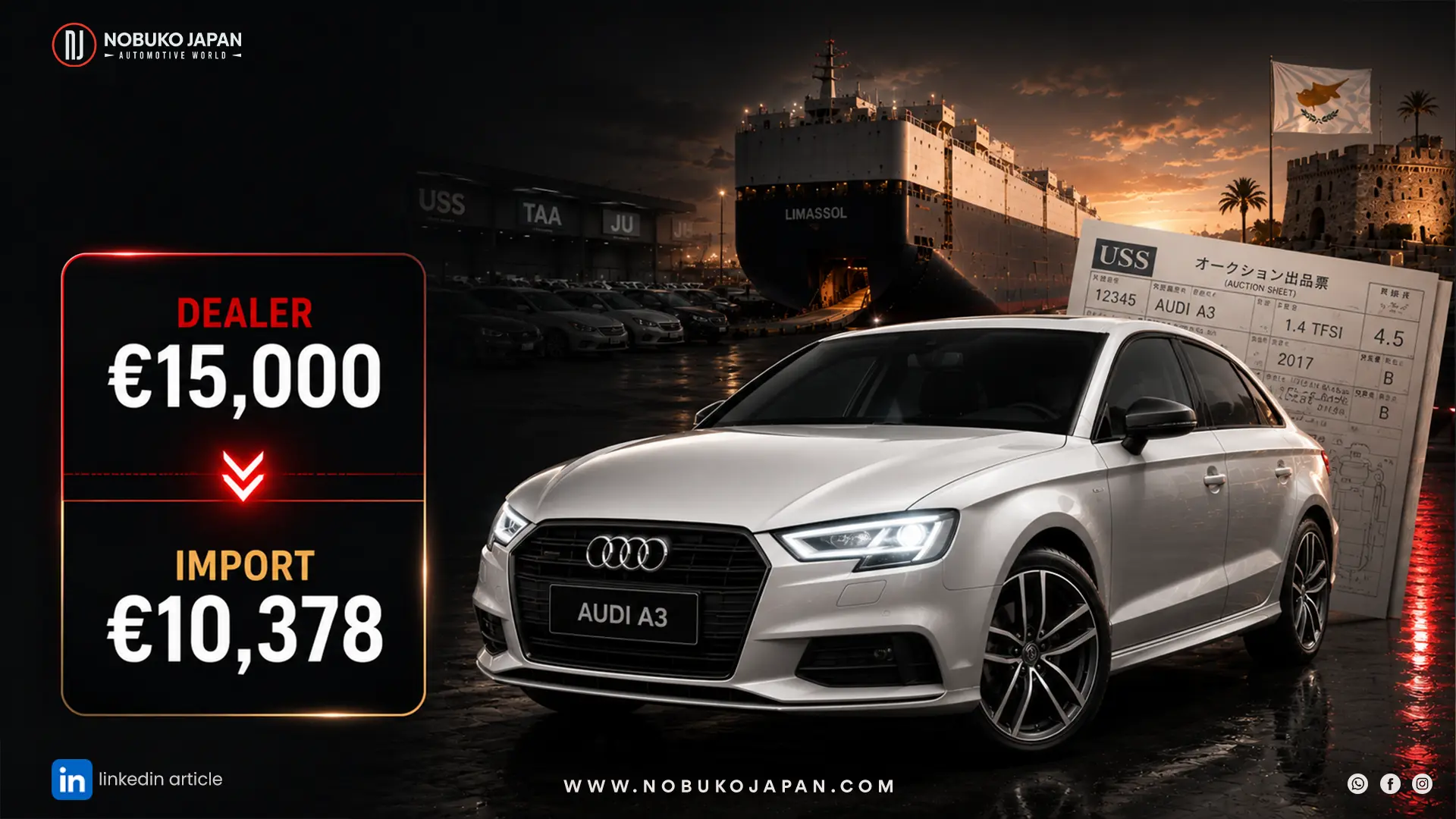
If you import a Japanese vehicle into Cyprus, you normally pay three main charges:
In addition, buyers should budget for customs clearance, port handling, roadworthiness testing (where applicable), registration documentation, and number plates. For many Japanese imports, the combined taxes and fees represent a significant addition to the vehicle's landed cost, making accurate budgeting essential before placing a bid.
Finding a low-mileage Japanese car at a competitive auction price is exciting, but many buyers make one costly mistake: they focus on the purchase price and overlook the taxes and fees required once the vehicle arrives in Cyprus.
Importing from Japan can still offer excellent value, but understanding the full cost is essential. Import duty, VAT, registration charges, customs clearance, and other mandatory expenses all contribute to the final amount you will pay before the car is legally registered.
At Nobuko Japan, we have helped buyers across Cyprus import Japanese vehicles with transparent pricing and professional guidance. Over the years, we've seen that the buyers who calculate every cost before bidding avoid unexpected expenses and make better purchasing decisions.For a complete seven-category breakdown of every cost from auction price to Cyprus driveway, read our total cost to import a car to Cyprus guide with real examples for the Toyota Aqua, Honda Fit, and Toyota RAV4.
This guide explains the key taxes, fees, and requirements involved in importing a Japanese vehicle into Cyprus, using practical examples to help you estimate the total landed cost before you buy.
Japanese vehicles remain popular among Cyprus buyers for several reasons.
Japan has strict vehicle inspection requirements, encouraging owners to maintain their cars to a high standard. As a result, many exported vehicles arrive in excellent mechanical condition.
Japanese drivers generally cover fewer kilometres each year than drivers in many European countries. This often results in lower-mileage used vehicles.
Many Japanese domestic market (JDM) vehicles include premium features such as advanced safety systems, hybrid technology, climate control, and upgraded interiors that may not be available on equivalent European models.
Buying directly from Japanese auctions often provides access to wholesale prices, making imported vehicles more affordable than purchasing similar models from local dealerships for a full comparison of auction versus dealer pricing including when each route makes sense for Cyprus buyers read our auction vs dealer guide for Japanese imports.
When importing a vehicle from Japan to Cyprus, three primary charges apply.
| Tax | Purpose |
| Import Duty | Charged because Japan is outside the European Union. |
| VAT (19%) | Applied to the CIF value plus import duty. |
| Registration Fee | Based on the vehicle's CO₂ emissions and other applicable registration criteria. |
These three charges form the core of your import costs.
Nobuko Japan Tip: Calculate these expenses before bidding, not after winning the auction.

Import duty is the first tax payable when your vehicle enters Cyprus.
The duty is calculated using the CIF value, which stands for:
Auction Price: €5,000
Shipping: €1,000
Insurance: €100
CIF Value:
€5,000 + €1,000 + €100 = €6,100
Assuming a standard 10% duty rate, the import duty would be:
€610
The applicable duty depends on the vehicle and current customs rules. Buyers should always verify the latest rates with the relevant customs authorities before importing Note that Cyprus, as an EU member state, applies the EU common external tariff rate on passenger cars. For verified rates and a full cost comparison with real examples, see our Cars from Japan to Cyprus buying guide.
Once import duty has been calculated, VAT is applied.
The standard Cyprus VAT rate is 19%.
Unlike many first-time buyers assume, VAT is not calculated only on the vehicle price.
Instead, VAT is calculated using:
CIF Value:
€6,100
Import Duty:
€610
VAT Calculation Base:
€6,710
VAT (19%):
€1,274.90
This brings the total taxes so far to:
| Charge | Amount |
| Import Duty | €610 |
| VAT | €1,274.90 |
| Total | €1,884.90 |
Expert Tip: One of the most common budgeting mistakes is calculating VAT only on the auction price. VAT is generally calculated on the customs value, which includes the CIF amount and applicable duty.
After customs clearance, the vehicle must be registered before it can legally be driven in Cyprus.
Registration costs depend primarily on environmental and vehicle-specific factors.
Typical considerations include:
Lower-emission vehicles, including many hybrids, generally benefit from lower registration charges than higher-emission vehicles.
Indicative examples:
| CO₂ Emissions | Estimated Registration Cost |
| Up to 120 g/km | €50–€100 |
| 120–150 g/km | €100–€300 |
| 150–180 g/km | €300–€700 |
| Above 180 g/km | €700–€1,500+ |
For example, a hybrid hatchback with low CO₂ emissions may incur a relatively modest registration fee, while a larger SUV with higher emissions is likely to attract a higher charge.
Nobuko Japan Tip: If your goal is to minimise registration costs, fuel-efficient hybrid models are often a practical choice.
Understanding each individual tax is useful, but what really matters is your total landed cost. Before placing a bid at a Japanese auction, you should calculate every expense from the auction hammer price to the final registration in Cyprus.
Let's use a practical example.
Vehicle: 2021 Toyota Aqua Hybrid
Auction Price: €6,500
Shipping: €1,100
Marine Insurance: €100
CIF (Cost + Insurance + Freight)
| Cost Component | Amount (€) |
| Auction Price | €6,500 |
| Shipping | €1,100 |
| Insurance | €100 |
| Total CIF Value | €7,700 |
For current auction availability and price ranges on the Toyota Aqua in 2026, see our latest Japanese car stock guide for Cyprus buyers.
Assuming a 10% import duty:
€7,700 × 10% = €770
VAT is calculated on:
CIF + Import Duty
€7,700 + €770 = €8,470
VAT (19%)
€8,470 × 19%
= €1,609
Toyota Aqua Hybrid
Approximate Registration Fee:
€80
| Tax | Amount (€) |
| Import Duty | €770 |
| VAT | €1,609 |
| Registration Fee | €80 |
| Total Taxes | €2,459 |
| Item | Amount (€) |
| Vehicle Price | €6,500 |
| Shipping + Insurance | €1,200 |
| Total Taxes | €2,459 |
| Subtotal | €10,159 |
Remember that customs clearance, port handling, registration documentation, and roadworthiness testing may add further costs depending on your circumstances.
Besides taxes, there are several administrative costs associated with importing a vehicle into Cyprus.
| Fee | Typical Cost (€) |
| Customs Clearance | €100–€200 |
| Port Handling | €50–€150 |
| Roadworthiness Test | €50–€100 |
| Registration Certificate | Approx. €9 |
| Number Plates | €20–€50 |
| Annual Road Tax | Depends on vehicle |
These expenses are relatively small compared to duty and VAT, but they should still be included in your budget.
Expert Tip: Setting aside approximately €500 for miscellaneous import costs helps avoid unexpected expenses during the registration process.
One important requirement for importing vehicles into Cyprus is the Economic Operators Registration and Identification (EORI) number.
An EORI number is used by customs authorities to identify importers and exporters involved in international trade.
For many private buyers, obtaining and managing an EORI registration can add administrative complexity.
Because of this, many importers choose to work with a professional exporter or customs clearing agent who can coordinate the customs process and ensure the required documentation is completed correctly. Before choosing an exporter, our guide to verifying a Japanese car exporter shows the seven checks that separate legitimate operators from untrustworthy ones critical before sending any payment.
At Nobuko Japan, we work with experienced customs partners to help simplify the import process for our customers.
Vehicle registration requirements can change over time, and buyers should always confirm the latest regulations before purchasing.
Historically, vehicle age has been an important consideration when importing cars into Cyprus. Older vehicles may be subject to additional requirements or restrictions depending on current legislation and environmental standards.
Before placing a bid:
Taking a few minutes to confirm eligibility before bidding can save significant time and expense later.
Many buyers calculate only the hammer price and ignore shipping, insurance, customs charges, and VAT.
Always estimate the complete landed cost before bidding.
VAT generally applies to the customs value, including applicable duty not just the vehicle price.
This is one of the most common budgeting errors.
Registration costs vary depending on the vehicle's emissions.
Choosing a lower-emission hybrid can reduce ongoing ownership costs.
A clean-looking vehicle may still have accident repairs or mechanical issues.
Always review the auction sheet before purchasing.
Buying directly without experienced support increases the risk of documentation errors, misunderstanding inspection reports, or overlooking additional costs.
Working with a trusted exporter helps streamline the entire process.
One of our customers from Limassol wanted to import a 2021 Toyota Aqua Hybrid.
Before bidding, we prepared a complete cost estimate covering:
Because every expected expense had been calculated in advance, the customer knew exactly what budget was required before the vehicle even left Japan.
Instead of facing unexpected costs after arrival, the customer completed the purchase with confidence and secured a high-quality hybrid vehicle at a lower overall cost than comparable vehicles available locally.
The biggest lesson from this experience was simple:
Calculate first. Bid second.
Car import tax generally includes import duty, VAT, and vehicle registration charges, along with other administrative costs required before the vehicle can be legally registered.
The standard VAT rate is 19%, although buyers should always verify the latest tax rates with the relevant authorities.
In many cases, lower-emission hybrid vehicles attract lower registration costs than larger petrol or diesel vehicles, but the exact amount depends on the applicable regulations.
It can be. Many buyers choose Japanese imports because they offer competitive wholesale pricing, lower mileage, and strong vehicle condition. However, the final value depends on the total landed cost.
CIF stands for Cost, Insurance, and Freight. It forms the basis for calculating customs duty and VAT during the import process.
Yes, but the process can be more complex. Many buyers prefer to work with experienced exporters who manage auction bidding, documentation, shipping, and customs coordination.
Shipping times vary depending on the vessel schedule, port availability, and shipping method. Your exporter can provide a more accurate estimate for your chosen vehicle.
Knowing the total landed cost helps you set a realistic budget and avoid purchasing a vehicle that exceeds your financial expectations once all import charges are added.
Importing a Japanese vehicle into Cyprus involves more than simply winning an auction. Buyers should understand the full cost of ownership, including import duty, VAT, registration charges, and administrative expenses before making a purchase.
By calculating your total landed cost in advance, checking the applicable import requirements, and working with an experienced export partner, you can avoid unexpected costs and make informed buying decisions.
At Nobuko Japan, we support Cyprus buyers through every stage of the process from auction sourcing and vehicle inspections to shipping and customs coordination. Our goal is to provide transparent pricing, professional guidance, and a smoother importing experience.
Nobuko Japan has more than 14 years of experience helping customers source and export quality Japanese used vehicles to Cyprus, the UK, and Ireland. Our team works with leading Japanese auction networks and trusted logistics partners to provide transparent pricing, vehicle inspections, and export support based on practical industry experience.
For Latest updates
Importing a Japanese vehicle into the UK, Ireland, or Cyprus in 2026 is a smart idea. It's excellent...

Japan's reputation as makers of best Japanese cars; electric-proof, high-tech, and exciting automobi...

There is more to buying a car in Japan than the auction price. The final price comes as a great shoc...
.png)
Importing a car from Japan to the UK is an exciting process. However, understanding the shipping tim...

