Owning a reliable and fully feature-packed car is definitely a key goal for many Pakistanis. The local market is often not the best place to get the right value but rather the Japanese themselves. Japanese used cars are actually quite famous for their build quality, fuel efficiency, and advanced safety features.
As a matter of fact, their low mileage and transparent vehicle history make them a smart buy. However, the import process can seem complex. This guide breaks it down into simple, actionable steps.
We will cover costs, legal paperwork, customs duties, and timelines. Indeed, choosing verified exporters and licensed clearing agents is very important in order to avoid scams.
Their low mileage and transparent vehicle history make them a smart buy. But the import process changed sharply in late 2025 and 2026. The government abolished the Personal Baggage scheme, tightened rules for overseas Pakistanis, and cut duties for commercial imports. This guide breaks down the current process step by step, with every rule updated for 2026.
Big Policy Update: Personal Baggage Scheme Abolished
On January 15, 2026, the Ministry of Commerce abolished the Personal Baggage scheme through SRO 61(I)/2026. This scheme once accounted for an estimated 99% of used-car imports into Pakistan. The government removed it because it had become a loophole for commercial imports disguised as personal ones.
Only two routes remain for individuals bringing in a personal vehicle:
Both routes carry a stricter set of conditions than before. Read them carefully before you plan your import.
| Rule | Old Rules (Pre-2026) | New Rules (2026) |
|---|---|---|
| Eligible schemes | Personal Baggage, Gift, Transfer of Residence | Gift and Transfer of Residence only |
| Waiting period between imports | 700 days | 850 days |
| Country of import | Any country of residence | Must be the importer's actual country of residence |
| Resale | No fixed ban in most cases | One-year resale ban applies |
| Vehicle age limit | Up to 3 years (cars), 5 years (other vehicles) | Same age limit stays, enforcement is stricter |
Use the Gift Scheme if a relative or sponsor abroad is sending you a car. Use Transfer of Residence if you are personally relocating back to Pakistan and bringing your own vehicle. Neither route allows the car to be registered and used purely as a commercial import.
Pakistani buyers prefer Japanese used cars for clear reasons. They offer higher build quality and better safety standards than many local alternatives. Their fuel efficiency is superior, saving money long-term. The auction system in Japan is highly transparent. All cars are provided with an auction sheet that properly discloses their status, mileage, and any repair. This implies that more features and reliability are offered at a cheaper price than in buying new or used locally.
Commercial Import Route: New for 2026
Since September 2025, Pakistan also allows commercial import of used vehicles up to 5 years old, separate from personal-use schemes. This route is for registered companies, not individuals.
If you are a dealer or plan to import at scale, this is the route to look at. Individuals bringing in one car for personal use should still use Gift or TR.
The draft Auto Policy 2026-31 also proposes an Import-Refurbish-Export scheme, modelled on Dubai's Jebel Ali system. Under this framework:
This scheme is still under negotiation with the IMF at the time of writing. It matters for businesses eyeing Pakistan as a refurbishment hub, not for a buyer wanting a car for personal use.
Before you start, gather these essential documents:
Your first step is finding a reliable partner in Japan. Use proven exporters with verifiable track records and physical offices. Check reviews and testimonials from past Pakistani customers. Red flags include companies that only operate on social media, refuse to share contact details, or quote prices that seem too good to be true. Reputable exporters have direct access to major Japan auction houses like USS, TAA, and CAA. Understand the pricing: FOB (Free on Board) is the car's cost at the Japanese port, while CNF (Cost and Freight) includes shipping to Pakistan.
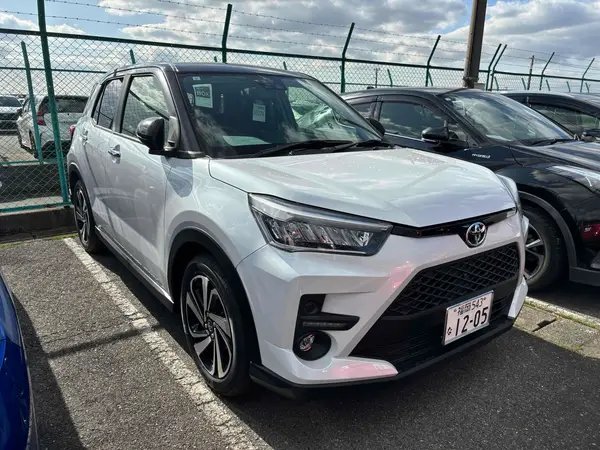
This is the most critical step. Japanese auction sheets are reliable records of a vehicle's condition. Know the grades: Grade 4 or 5 is excellent, 3.5 is very good, and Grade R means the car has already been repaired due to severe damage. Check these codes on the sheet: A means a slight scratch, B means a dent, U means rust, and S means a repair. A clean interior is marked "E." Avoid cars with "XX" markings, which signal major structural issues. The recorded mileage is almost always accurate.
Never bid on a car without calculating the total landed cost. The final price includes:
2026 duty structure by engine size (commercial imports, before the Budget 2026-27 cuts take full effect)
| Engine Capacity | Customs Duty | Notes |
|---|---|---|
| Below 1300cc | ~50% | Plus 17-18% GST, ACD, and RD where applicable |
| 1300cc-1800cc | ~65% | Plus GST, ACD, and RD where applicable |
| Above 1800cc | ~75% | Plus GST, ACD, and RD where applicable |
Hybrid vehicles get a waiver: roughly 50% for engines under 1800cc and 25% for 1800cc-2500cc, though a new Green Tax now applies to hybrids and EVs alike. Under the Budget 2026-27 proposal, the government aims to cut the cumulative import tax on hatchbacks from around 150% toward 70%, which would put an imported 1000cc Japanese hatchback close to the price of a locally assembled sedan.
Other charges to plan for:
Note: Duty rates are highest for large engines. Smaller engines (660cc, 1000cc) and hybrid cars carry lower duties, making them the most cost-effective imports in 2026.
Once you win a bid, the exporter sends a pro forma invoice. Use secure bank transfer methods like Telegraphic Transfer (TT) or a Letter of Credit (LC). Never send money to a personal account or through informal channels. Get a payment confirmation and copies of the Bill of Lading and final invoice.
Shipping takes 20 to 40 days. Most used cars ship via Roll-on/Roll-off (RO-RO) vessels. Your exporter handles this and provides the Bill of Lading, your official receipt, and title for the shipment. You can track your car's voyage online with this document. The main arrival ports in Pakistan are Karachi Port and Port Qasim.
Hire a licensed clearing agent. They know the WeBOC (Web-Based One Custom) system and manage the customs clearance. Give them all your documents: Passport, CNIC, NTN, Bill of Lading, Invoice, and Auction Sheet. The agent files the goods declaration in WeBOC, pays the assessed duties via a pay order, and handles port charges. Once all duties are paid, your car is released from the port terminal.
The final step is registering your car with the local Excise & Taxation Office (in Karachi, Lahore, etc.). You need your CNIC, passport, all customs clearance documents, the original Bill of Lading, and the purchase invoice. After verification and road tax payment, you receive your official number plates.
How old a Japanese car can I import to Pakistan in 2026?
Under the Gift and Transfer of Residence schemes, cars must generally be under 3 years old from manufacture date. Commercial imports had a 5-year cap that was lifted entirely from July 2026. Always confirm the latest FBR rules before bidding.
Can I still use the Personal Baggage scheme?
No. It was abolished on January 15, 2026 through SRO 61(I)/2026. Only Gift and Transfer of Residence remain for individuals.
How much duty do I pay on a 660cc or hybrid car in 2026?
Duty is a percentage of the assessed value. Smaller engines and hybrids carry lower duty rates, though a new Green Tax now applies to hybrids too. Use the FBR's online import duty calculator for a precise estimate.
What is the Import-Refurbish-Export (IRE) scheme?
A proposed framework letting licensed companies import used cars, refurbish them in Pakistan, and re-export them within nine months. It does not apply to personal-use imports.
Is importing cheaper than buying locally in 2026?
Often yes, and the gap is set to widen. Budget 2026-27 duty cuts are pushing the cost of imported hatchbacks closer to locally assembled cars, while giving buyers access to newer, better-equipped models.
How do I verify if an auction sheet is original?
A reputable exporter provides it. Cross-check the chassis number on the sheet against the car's images. Fake sheets often have blurry logos or inconsistent fonts.
Importing a used Japanese car to Pakistan in 2026 works differently than it did a year ago. The Personal Baggage scheme is gone. Gift and Transfer of Residence are now the only personal routes, with stricter conditions. Commercial imports have opened up with falling duties. Success still comes down to the same fundamentals: read the auction sheet correctly, calculate duties under the current structure, and work with a licensed clearing agent.
For Latest updates
2026 Costs Breakdown: Importing a Japanese Car to UK, Ireland and CyprusImporting a Japanese vehicle...

Japan's reputation as makers of best Japanese cars; electric-proof, high-tech, and exciting automobi...
There is more to buying a car in Japan than the auction price. The final price comes as a great shoc...
.png)
Importing a car from Japan to the UK is an exciting process. However, understanding the shipping tim...