Lower price, lower mileage, no rust, full service history, better specs, and 0% duty under EU-Japan EPA
By Nobuko Japan Import Team | Updated: April 2026 | 100+ Irish imports handled since 2014
EU-Japan EPA Verified | USS Auction Sourced | MLIT Emissions Data | NCTS and Revenue Compliant
| Irish buyers choose Japanese import cars for seven reasons price (30 to 50% lower than Irish dealers), mileage (5,000 to 7,000 km per year versus 12,000 to 15,000 in Ireland), no rust from road salt, full Shaken-verified service history, higher specifications than European export models, 0% customs duty from February 2026 under the EU-Japan Economic Partnership Agreement, and access to unique models like the Toyota Alphard, Toyota Voxy, and Mitsubishi Delica that were never sold in Ireland. The main downsides are an 8 to 14 week wait, no warranty, and slightly higher specialist insurance. |
Three factors combine to make Japanese auction cars significantly cheaper than Irish dealer cars. First, Japan runs weekly auctions through USS (Universal Auto Auction), TAA (Toyota Auto Auction), and JU Net with millions of cars entering the market every year. High supply keeps prices low. Second, the Japanese yen has depreciated approximately 30% against the euro over five years, meaning your euro buys more car than it did in 2019. Third, importing directly from Japan cuts out Irish dealer margins entirely.
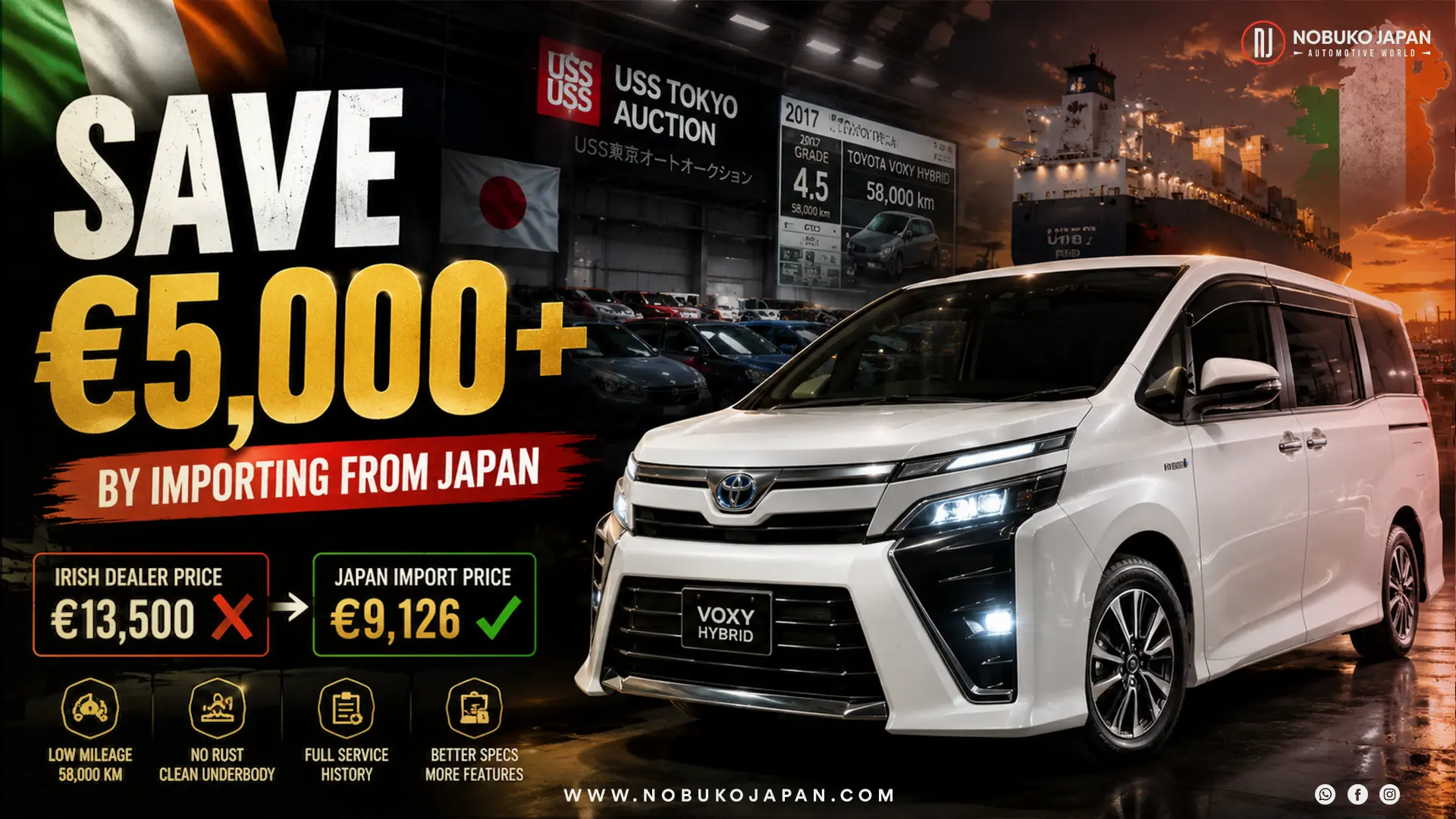
On a 2017 Toyota Voxy, an Irish dealer charges €12,000 to €14,000. The same car sourced from USS Tokyo auction, shipped via RoRo (Roll-on Roll-off) to Dublin Port, and landed with 0% customs duty under the EU-Japan Economic Partnership Agreement, 23% VAT to Revenue Commissioners, and VRT at the NCTS centre costs approximately €7,500 to €9,500. The saving on a single car runs €4,000 to €6,500. That gap is consistent across every model we have shipped.
Japanese drivers average 5,000 to 7,000 km per year. Irish drivers average 12,000 to 15,000 km. The difference comes from two factors. Japan has one of the world's most efficient public transport networks. Many Japanese families commute entirely by train and use their cars only at weekends or for occasional trips. The second factor is the Shaken system.
Shaken is Japan's mandatory vehicle roadworthiness inspection, required every two years after a car's first three years. It covers engine condition, brakes, emissions, and underbody integrity and costs between €500 and €1,500 depending on the car's age and condition. Because older or poorly maintained cars fail Shaken and become expensive to keep, Japanese owners either service their cars rigorously or scrap them early. The cars that reach Irish buyers through auction are the well-maintained ones.Understanding auction grades and condition reports helps you identify these well-maintained cars. Our Japanese auction sheet reading guide explains every grade code in plain English A 10-year-old Japanese car typically has 60,000 to 80,000 km. An Irish car of the same age often has 130,000 to 150,000 km.
Japan uses significantly less road salt in winter than Ireland. Most Japanese regions see little snow and in those that do, cars are washed promptly. The result is that underbody corrosion, one of the most common reasons Irish cars fail NCT, is rare on Japanese imports even at 10 to 15 years old.
Nobuko Japan shipped a 2008 Toyota Vitz to a buyer in Limerick in 2024. The car had 70,000 km. The buyer's mechanic inspected the underbody and reported it looked like a three-year-old Irish car. Clean sills, no corrosion on the suspension components, and exhaust bolts that came off without damage. In Ireland, that condition is exceptional on a 16-year-old car. On a Japanese import, it is standard.
Japanese auction grades include a service history assessment. A Grade 4 or Grade 4.5 car from USS, TAA, or JU Net almost always carries full dealer service stamps from a single garage throughout its life. Every oil change, every filter, every timing chain service is recorded. The Shaken inspection system reinforces this. A car that misses services fails Shaken and becomes difficult to sell at auction.
Irish used cars regularly arrive with incomplete history. Missing stamps, cash job servicing, and lost log books are common. For buyers who want to know the full mechanical story of a car before they purchase, Japanese auction documentation provides a level of transparency that the Irish used car market rarely matches.
Japanese domestic market cars are built for Japanese buyers, who expect higher standard equipment than European markets typically demand. A 2012 Toyota Vitz sold in Japan comes with touchscreen navigation, climate control, push-button start, alloy wheels, and factory window tint as standard equipment. The equivalent European Toyota Yaris from the same year has a basic radio and manual air conditioning. The specification gap between domestic Japanese models and European export versions is consistent across nearly every manufacturer.
The Toyota Alphard makes the point most clearly. It was never sold in Ireland at all. No Irish dealer has ever stocked it new. Electric sliding doors on both sides, rear entertainment screens, captain's chairs with Ottoman reclining function, and the Toyota Hybrid Synergy Drive system are standard features on a car that costs €8,000 to €11,000 landed in Ireland. For full specifications, VRT estimates, and auction prices on the Toyota Alphard and other premium Japanese models, see our best Japanese cars to import guide. The closest European equivalent, the Mercedes V-Class, starts at €25,000 used.
No. From February 2026, cars manufactured in Japan pay 0% customs duty in Ireland under the EU-Japan Economic Partnership Agreement (EPA). Before this date, Irish buyers paid 10% duty on the combined CIF value (car price plus shipping plus insurance). On a €7,000 car with €1,200 shipping, that was €820 in duty before VAT. That charge is now zero for Toyota, Honda, Nissan, Mazda, Suzuki, and Subaru models built in Japan.
To claim the 0% rate, your customs agent must file the Certificate of Origin with the customs declaration. Without it, Irish Revenue Commissioners apply the standard 10% EU duty by default. Nobuko Japan includes the Certificate of Origin with every shipment as standard. The Certificate of Origin is one of six documents required for Irish customs clearance. Our step-by-step guide to importing a car from Japan to Ireland covers every document and deadline in full.The saving of €700 to €1,500 per car is permanent under the EPA, not a temporary exemption.
Several of the most popular Irish imports were never sold through Irish dealerships. The Toyota Alphard, Toyota Voxy, Honda N-Box, Suzuki Every, and Mitsubishi Delica D5 are only available in Ireland as imports. These models were designed for the Japanese domestic market and were never part of any manufacturer's Irish distribution plan.
For Irish buyers who want something different from the standard Ford, Volkswagen, and Toyota dealer inventory, Japan is the only source. These models also hold their value well in the Irish used market because supply stays limited. A 2016 Toyota Voxy imported in 2023 typically retains 85 to 90% of its Irish landed value two years later because no Irish dealer can undercut it with new stock.
A customer from County Cork needed a 7-seat family car for school runs and weekend use. He visited two Irish dealers. A 2017 Toyota Voxy with 110,000 km was priced at €13,500. A 2016 Nissan Elgrand with 120,000 km was €12,000. Both had incomplete service history.
Nobuko Japan sourced a 2017 Toyota Voxy Hybrid Grade 4.5 from USS Tokyo. The car had 58,000 km, full dealer service stamps, no accident record, and official MLIT CO2 emissions data confirming 110g/km. That CO2 figure placed it in the 13.5% VRT band at the NCTS centre. Total landed cost to Dublin Port was €9,126. His saving against the Irish dealer Voxy: €4,374.
The car has been on Irish roads for over a year. Zero repairs. The Toyota Hybrid Synergy Drive system averages €60 per week in fuel versus €90 for the petrol Voxy he originally considered. First NCT passed without issues.
His verdict: My neighbours thought I was mad importing from Japan. Now they all want to know how I did it. The car is perfect and I saved nearly €4,500.
The wait time is the most common objection. From auction win to Dublin Port delivery takes 8 to 14 weeks. If you need a car within six weeks, importing is not the right choice. Buy locally for immediate need and import when timing allows.
| Reason | Japanese Import | Irish Dealer Car |
| Purchase price | 30 to 50% lower | Full retail price |
| Annual mileage | 5,000 to 7,000 km per year | 12,000 to 15,000 km per year |
| Rust condition | Minimal, low road salt use in Japan | Common, Irish road salt damage |
| Service history | Full Shaken-verified stamps | Often incomplete |
| Specifications | Higher than European export models | Standard European spec |
| Customs duty (2026) | 0% under EU-Japan EPA | Not applicable |
| Unique models | Alphard, Voxy, N-Box, Delica | Not available in Ireland |
Lower price, lower mileage, no rust, and full service history. In 2026, 0% customs duty under the EU-Japan EPA adds €700 to €1,500 in additional savings per car.
€4,000 to €6,500 on a family car like a Toyota Voxy. Total landed cost runs €7,500 to €9,500 versus €12,000 to €14,000 at an Irish dealer for the same model.
Yes. Shaken inspections every two years force proper maintenance. A 10-year-old Japanese import typically has 60,000 to 80,000 km and full service documentation.
8 to 14 week wait, no warranty, and specialist insurance required. For most buyers the purchase saving outweighs these by several thousand euros.
About This Guide
Written by the Nobuko Japan import team based on 100+ Irish imports handled since 2014. Auction price data sourced from USS, TAA, and JU Net 2025 to 2026 records. VRT rates from Irish Revenue Commissioners published schedules at revenue.ie.EU-Japan EPA duty rates from official EPA documentation. Last reviewed: April 2026.
For Latest updates
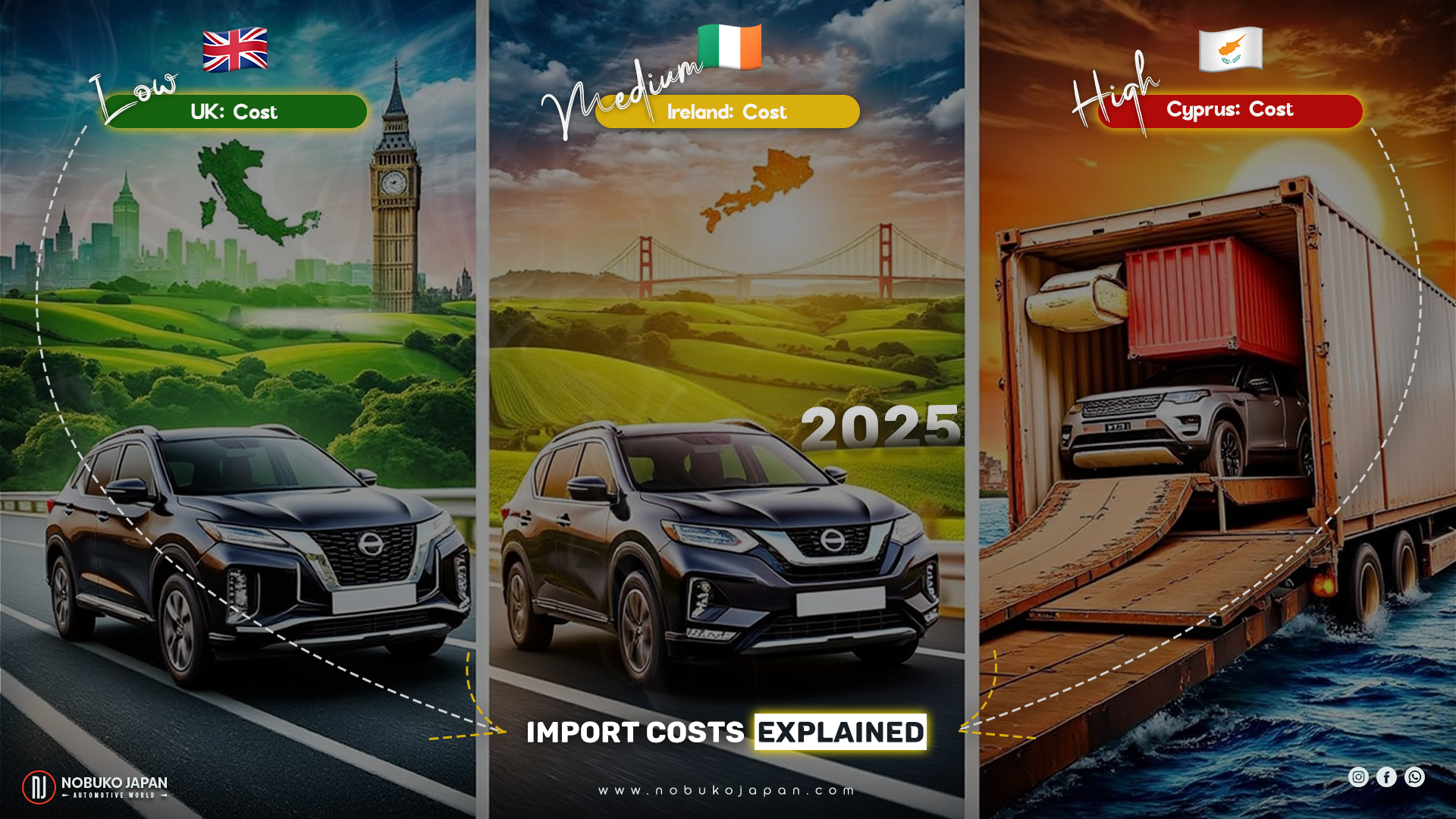
Importing a Japanese vehicle into the UK, Ireland, or Cyprus in 2026 is a smart idea. It's excellent...

Japan's reputation as makers of best Japanese cars; electric-proof, high-tech, and exciting automobi...

There is more to buying a car in Japan than the auction price. The final price comes as a great shoc...
.png)
Importing a car from Japan to the UK is an exciting process. However, understanding the shipping tim...